
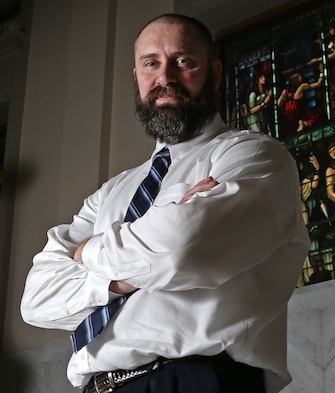
Hillsdale will host Robert Holmstedt, the Professor of the Hebrew Bible and West Semitic Languages at the University of Toronto during the spring semester to teach a class on early Judaism.
Holmstedt said he has always been interested in the Judeo-Christian roots of American cultural, religious, and linguistic norms.
“My graduate program was called ‘Hebrew and Semitic Studies,’ and there was a specific Jewish studies component to that, but I really consider myself within Biblical studies, and that cuts across both early Christian and early Jewish studies,” Holmstedt said.
Professor of Philosophy Lee Cole said Holmstedt came to Hillsdale as a visiting scholar, and his class was quite popular. According to Cole, a donor contacted him in 2022 with an interest to supplement a one-week course taught by a guest scholar, covering scripture and scriptural commentary especially in the Jewish tradition.
Cole said Holmstedt found Hillsdale to align with his interests as well.
“Robert brings with him an impressive record of teaching and publishing, and so I feel quite fortunate that he’s offered to share some of his expertise with our students, especially in an area that’s probably under-serviced at the college,” Cole said. “He’s also an incredibly collegial person who is deeply supportive of our mission and work at the college. I’ve very much enjoyed getting to know him and his lovely family.”
According to Holmstedt, rabbinic literature has a fascinatingly dialogic character, in which the rabbis entertain and mull over a plethora of ideas.
“There’s this dialogue between rabbis,” Holmstedt said.“So-and-so says this, and so-and-so says another thing — each has opinions, but so many of the commentaries and so much of the literature comes from previous opinions that have been pulled together, and they don’t necessarily advocate one or the other.”
A knowledge of Jewish theology can be incredibly rewarding for Christians in their understanding of their own religion and vice versa, Holmstedt said.
“The way I teach the New Testament for Christians and Mishnah for Jews is that they both function in very similar ways, in that they both provide an interpretive lens for reading the earlier scriptures — the Tanakh for Jews, and the Old Testament for Christians,” Holmstedt said, “But they’re very different, because the New Testament has a great deal of narrative, letters, and teachings, but the Mishna has very little narrative and a lot of what different rabbis said, and then how they responded to each other.”
This more discursive style leads to opportunities for lots of variation in philosophical reasoning and in the everyday lives of those shaped by such traditions, Holmstedt said.
“You can see this through the medieval period and into the current period, where you have different groups. For example, the Hasidic Jews may wear different hats and have different groups because they live in different communities,” Holmstedt said. “You have this incredible variety, and that’s why it’s very difficult to systematize Jewish theology.”
According to Holmstedt, understanding the way ancient groups thought about themselves and their stories can help modern scholars to interpret scripture.
“It’s the cultural backdrop that helps us to understand some of the things we find in Biblical text,” Holmstedt said.
Even though students will have to wait until the spring to take a Holmstedt class, they can look out for opportunities for chance conversations with someone who specializes in the context of their religions.
“If students overhear a tall, bearded man—possibly wearing a brimmed hat—talking with a mild Canadian accent, they should introduce themselves,” Cole said.