
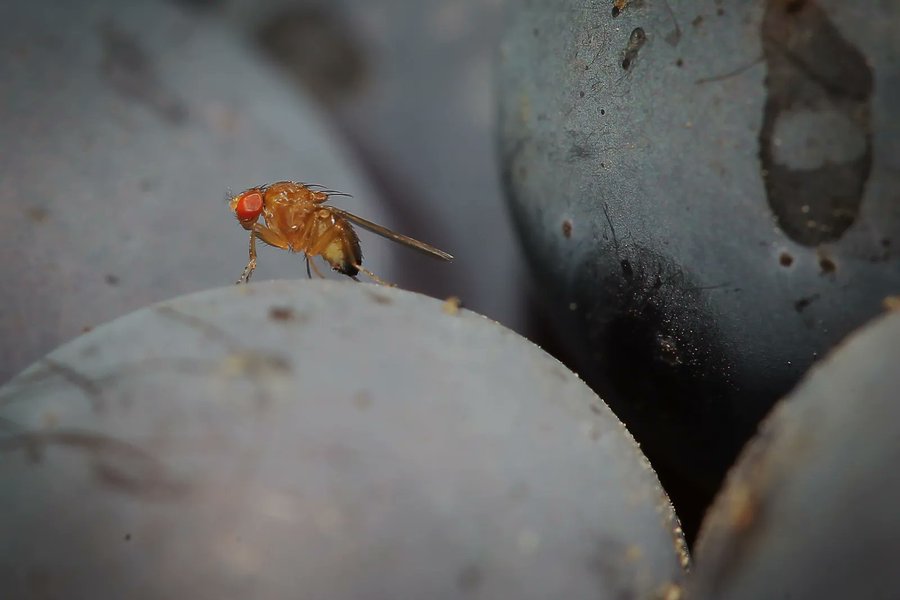
Senior Cecilia Gulick presents research on editing the genes of a fruit fly. Courtesy | Twitter
Senior Cecilia Gulick gene-edited fruit flies, and she hopes that other students will be able to build on her research, which she conducted for her senior thesis entitled “CRISPR Cas-9 in Drosophila melanogaster.”
Gulick discussed the background, process, results, and relevance of her research during a presentation on Feb. 29. She said the end goal of the project was to optimize CRISPR, which stands for Clustered Regularly Interspaced Palindromic Repeats.
CRISPR can be used in making genetic modifications, in this case to Drosophila melanogaster — a species of fruit fly.
“It’s little snippets of DNA, and paired with a Cas-9 protein, it’s able to identify the sequence on the genome of any organism.” Gulick said. “And then from there, it makes a double stranded cut.”
Gulick first got the idea for her research project from her academic and research advisor, Professor of Biology Jeffrey VanZant.
“I said, ‘Here are my goals. What do you think I should do?’ And he said, ‘I’m trying to do this thing called CRISPR,’” Gulick said. “And so I did research on it and wrote a proposal.”
Gulick said the research process starts with a proposal, which includes everything required for a scientific study — an introduction, a hypothesis, methods, materials, and a conclusion about what they plan to do with the study.
Gulick began her research in her sophomore year.
Gulick said her research focused on comparing two different guide RNAs. Guide RNA is the component of CRISPR Cas-9 that identifies the DNA sequence to be edited.
Gulick said she wanted to figure out why one guide RNA was more successful and efficient than another, and she had planned to do all of her research in six weeks with Hillsdale’s research grant.
“I didn’t realize the skill sets it involves just take practice,” Gulick said. “So I actually wasn’t able to get results in the end. It was a lot of troubleshooting, which I anticipated might be the case, because we hadn’t done it before at Hillsdale.”
Gulick’s first step in the process was modifying a plasmid — a small DNA molecule — by inserting a guide RNA. After sequencing it to make sure the modification had happened, Gulick injected the plasmid into fly embryos and raised flies, but she had a very low survival rate — one fly in 500 injected eggs survived.
Gulick said that because of this, she wasn’t able to cross her flies with others to see how the modified genes were expressed, but she said she was able to make progress.
“I did get something,” Gulick said. “One of my guide RNAs was much more difficult to sequence, but that was ironically also the one that works much better in my research.”
Gulick said she enlisted the help of VanZant, associate professor of biology Sang-Chul Nam, and biology core lab manager Kiralyn Brakel.
“Dr. VanZant was really helpful on the primer side or doing analysis of my DNA data,” Gulick said. “Dr. Brakel was also really helpful in keeping me going throughout that process. Then I went to Dr. Nam because he understands fly genetics specifically.”
Gulick said that the project taught her greater independence in the lab.
“Being able to work with unfamiliar things without much instruction was really big,” Gulick said. “Another thing that was really helpful was just learning to come to understand something on my own that was complex.”
Senior Katherine Harvey, who attended the presentation, said Gulick presented the information so clearly that even someone without a biology background could understand her research.
“Learning about the extensive and detailed process she created and followed to do the research greatly increased my respect for students in the hard sciences,” Harvey said.
Junior Jonah Morin said he also enjoyed Gulick’s presentation.
“As CRISPR is becoming more prominent and well known, I thought it was very informative on what it is and how it works,” Morin said.
Gulick plans to submit her fully written thesis sometime in April and have a second reader look at it before presenting it at another college.
“If I went to grad school, then I probably would look into CRISPR a little bit more,” Gulick said. “But as of right now, I’m not planning on going to grad school, so I’m kind of like — I learned a lot, and it was part of my Hillsdale experience.”
Gulick hopes that her project will make further research on CRISPR at Hillsdale easier.
“I think it could open up a lot of really interesting questions and interesting research topics,” Gulick said. “So I hope that protocol that I was able to help develop would let other students go farther with it.”
