
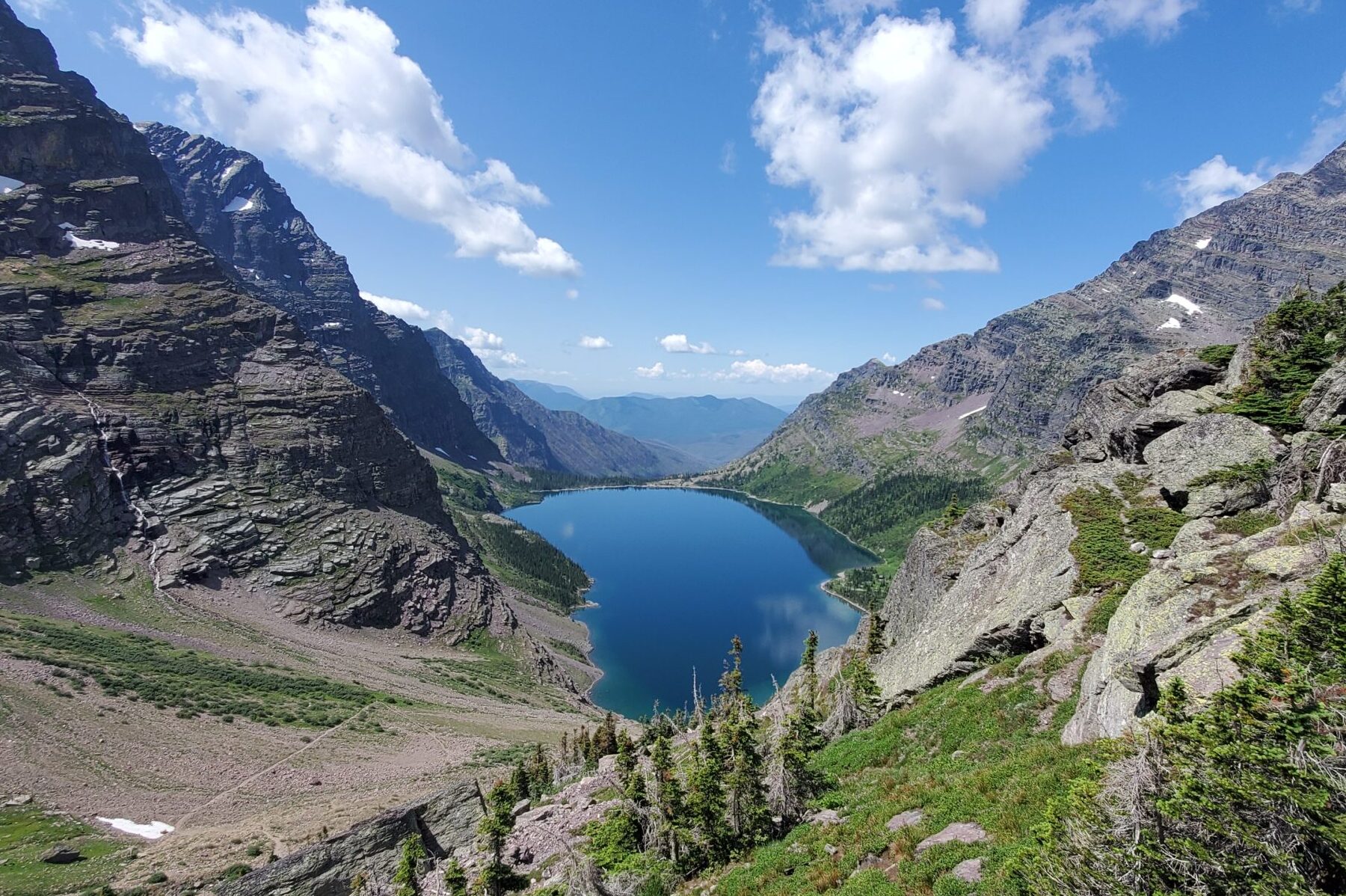
Lake Ellen Wilson in Glacier National Park. Courtesy | Sierra Dilworth
Montanans in the college community have divided reactions to a recent court decision that says the state’s promotion of fossil fuels violates the Montana Constitution.
Charles Steele, chairman of economics, business, and accounting, grew up in Montana before studying and then teaching at Montana State University. Steele, who has studied climate policy, said in an email that he thinks eliminating fossil fuels would be a disaster.
“An honest accounting of fossil fuel use would find overwhelming net benefit,” Steele said. “Any contemporary, developed society that attempts to eliminate fossil fuels will find this course is unsustainable, and if successfully pursued it will lead to poverty and death.”
When fossil fuels such as coal, oil, and natural gas are burned, they release carbon dioxide, which is known as a “greenhouse gas” because of its ability to trap heat around the earth. Some people, including scientists cited in the court ruling, are concerned too many greenhouse gasses in the atmosphere will cause destructive global warming.
Under the new ruling, potential climate effects of carbon dioxide may play a role in the approval process for some state-sponsored projects.
Sixteen Montana youth brought the constitutional challenge against the state’s fossil fuel-based energy system in 2020, saying it contributed to climate change, violating their rights under the Montana Constitution.
Sierra Dilworth ’23 said in an email that while finding a good alternative to fossil fuels is difficult, she admires the young activists’ initiative. Dilworth lived in Kalispell, Montana, near Glacier National Park before moving to California this summer.
She said she is glad their case could be heard despite attempts by elected officials to stop it from going to court.
“I have lived in Montana for the past nine years,” Dilworth said. “In just those nine years I have perceived a noticeable increase in haze from pollution in my valley, the Flathead Valley. Flathead County’s population has steadily grown every single year since 2010. People are flocking to Montana because they see that it is a beautiful place. However, if measures are not taken to protect the state’s environment, its beauty will slowly but surely be stripped from it.”
The 16 plaintiffs mentioned various harms related to changes in the environment, including sickness from wildfire smoke, inability to enjoy outdoor activities, and despair about the future.
Judge Kathy Seeley of Montana’s First Judicial District Court cited these harms and blamed them on the use of fossil fuels in her Aug. 14 ruling against the state.
Steele said neither these harms nor their alleged connection to fossil fuels were demonstrated.
“Seeley’s decision relied on numerous allegations that are clearly contrary to fact,” Steele said. “Seeley claimed Montana is a major emitter of greenhouse gasses, yet Montana accounts for less than 1% of U.S. emissions, according to data from the NSF’s National Center for Atmospheric Research.”
The Montana Constitution includes “the right to a clean and healthful environment,” and provides that, “The state and each person shall maintain and improve a clean and healthful environment in Montana for present and future generations.”
Reagan Linde ’22 said in an email that the environment is incredibly important, especially to Montanans. Linde is originally from Billings, Montana, and she now serves as assistant director of student activities and student programs.
“We are called to be stewards of the earth and I think that most people recognize this in some way, shape, or form,” Linde said. “Growing up in such a beautiful state where you spend a considerable amount of time in nature creates a certain fondness for the tranquility and beauty of the space you are in that should make you want to preserve it.”
She said while she does think the climate is changing, she does not think this is completely unprecedented or caused entirely by humans. She also said while many Montanans are glad their state is paying attention to the environment, the state is much more conservative than it was in 1972 when environmental protections were added to the state’s constitution.
The 16 plaintiffs argued that Montana’s current environmental laws violate these constitutional protections.
The Montana Environmental Policy Act requires environmental reviews for some state-sponsored projects. The law didn’t allow agencies to consider out-of-state effects, so agencies assumed they weren’t allowed to consider climate impacts.
Montana’s Gov. Greg Gianforte, a Republican, signed a bill in May making this clear. The amended version of the MEPA says that an environmental review “may not include an evaluation of greenhouse gas emissions and corresponding impacts to the climate.”
Later that month, the governor signed another bill amending the MEPA. This bill said that a challenge to an environmental review couldn’t stop an agency from proceeding if the challenge was based on greenhouse gas emissions.
“It seems that Gov. Gianforte wishes to inhibit proposed measures to put checks on environmentally abusive policies and procedures,” Dilworth said. “The lack of environmental transparency which Gianforte seems to be promoting between policy makers and Montanan people is not just a problem with the state of Montana; it is endemic in politics today.”
The ruling overturned both of these recent laws. Agencies will be permitted to consider greenhouse gas emissions in their environmental reviews, and people will be able to sue them if they don’t.
“I know that many Montanans are also not thrilled about the vague phrasing and judicial activism element,” Linde said. “They recognize that this ruling could set a precedent that would be difficult to enforce without a severe hit to some of our state’s top industries.”
The State of Montana has a 60-day window to decide whether to appeal the ruling to the Montana Supreme Court. Steele said he hopes the decision will be overturned on appeal.
“These climate court cases are a form of lawfare designed to circumvent democratic processes and impose radical economic and political change,” he said. “They are a threat to freedom and self-government.”
