
Can you describe to me the focus of your research?
To put it simply, there are different substances that we use in the lab, and they’re called viability reagents. They test how alive a culture of cells is. We had one that we had been using historically in the lab, but it had some problems, so Dr. Steiner wanted me to analyze a new reagent and see if it would still be effective, even if we used different antibiotics with it.
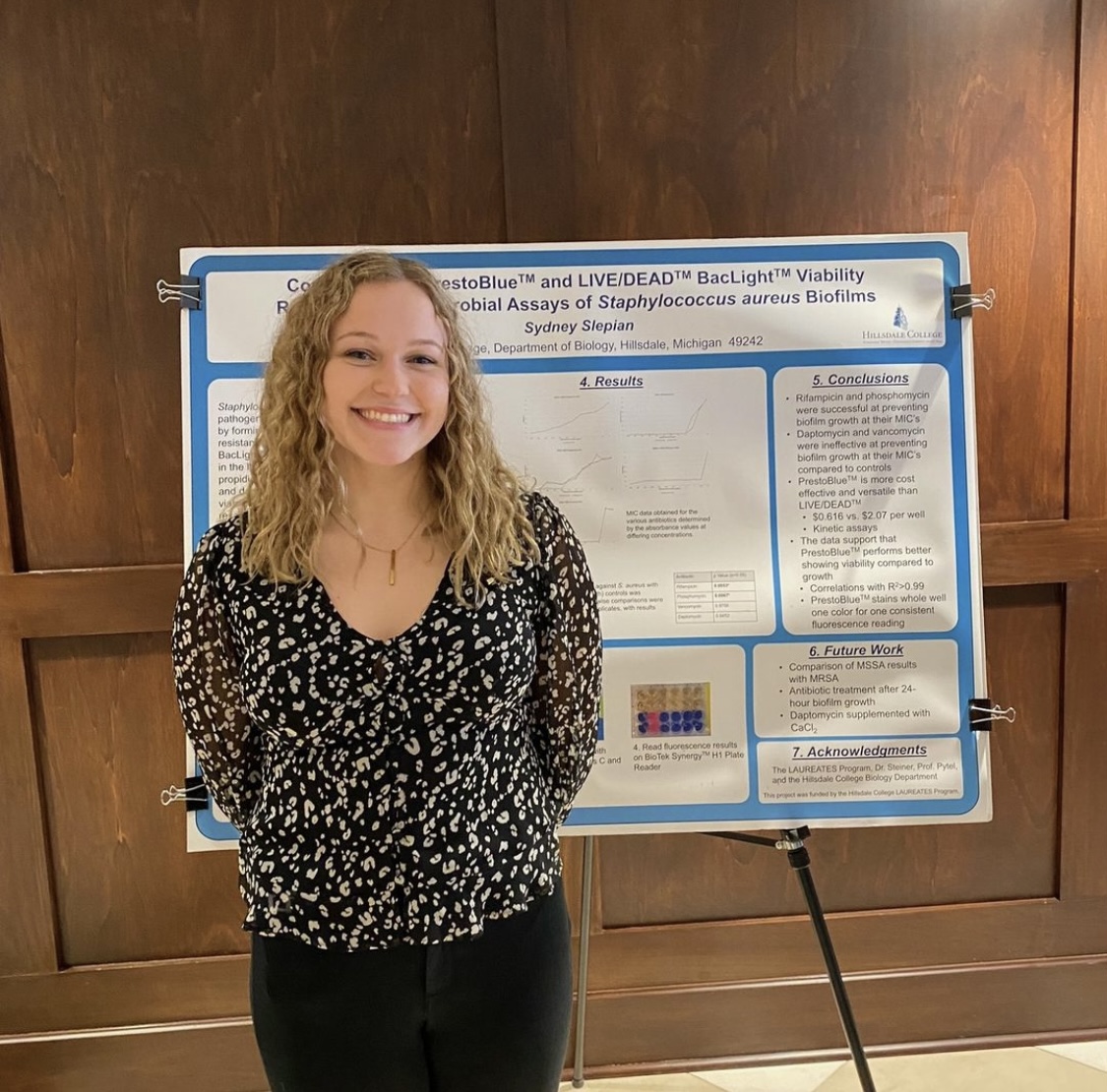
Overall, I was doing antibiotic assays and comparing the previously used LIVE/DEAD Viability reagent versus the new PrestoBlue Viability reagent.
What was the process of going through that?
First of all, I had to determine the minimum inhibitory concentration or the minimum inhibitory concentration of the different antibiotics, because not every antibiotic is as potent as the other ones. For some you need to add a different amount to get the same effect, so I first determined the MIC’s have all of the antibiotics that I would be using, and then I started making cultures of MSSA, which was my model organism for the experiment. It’s Methicillin sensitive Staphylococcus aureus, so I made cultures of the MSSA and then grew them on certain culture plates to create biofilms.
They’re of great interest to research, especially medical research. We created biofilms of the MSSA and then I applied the antibiotic to certain columns within the plate, and then incubated them for 24 hours. The plates had four rows across and six columns, so to the top two rows, I added in the LIVE/DEAD reagent, and then the bottom two rows, I added in the PrestoBlue reagent.
Every single day I was reading plates, because I would get three replicates per plate, I would get 12 spreadsheets that I would then have to form into one and process all the information for it. The last three or so weeks of research, I was getting 12 spreadsheets a day and trying to process all that information.
Could you describe the findings of your research?
Overall, I was analyzing four different antibiotics. Those four were Rifampicin, Phosphomycin, Vancomycin, and Daptomycin. What I was trying to determine was if the biofilm growth would be inhibited by these antibiotics after the 24 hours of growth.
I found that Rifampicin and Phosphomycin were successful in preventing the growth of the biofilms whereas Daptomycin and Vancomycin were not which was an interesting finding, because Vancomycin is widely used not only in the lab, but in hospitals as well.
That tells us that maybe the strain that we’ve been using of MSSA is actually resistant to Vancomycin. That’s what I found on that side, and then for the LIVE/DEAD versus PrestoBlue for the reagents, I found that the PrestoBlue was more consistent, versatile, and cost effective than the LIVE/DEAD, so considering it’s a new reagent, it’s recommended by my research that we implement it in the lab instead of the one that we had previously been using.
How do these findings affect the common man in the day-to-day?
Well, more with the results of antibiotics, because I don’t think that many people know how antibiotics are tested or the varying concentrations at which they’re used. And biofilms, they can grow within our bodies as the bacteria attached to our substances.
Biofilms are hard to eradicate compared to planktonic colonies. For this research, it was analyzed that the PrestoBlue reagent is advantageous in not only lab use, but in hospital use in determining the resistance of certain bacteria to certain drugs. It helps give them insight into which drugs to administer and also which drugs will be effective at which concentrations.
Why did you choose this topic?
I knew I wanted to work with Dr. Steiner from the onset, because I had him for two classes. It was BIO 202 at the time but now it’s BIO 200, and then microbiology. I genuinely loved all of the staining techniques and everything that we were doing in the lab. Also, I started working at Hillsdale hospital in the laboratory in April. Before that, and especially through working at the hospital in the lab, I was very interested in the idea of antibiotic resistance and how certain bacteria can acquire resistance to the antibiotics that we are giving them.
Going into the research, I wanted to examine antibiotic resistance, and I was able to do that in a way because my results were indicative that the bacteria are resistant to Daptomycin, but I would love to explore more of the actual mechanism behind antibiotic resistance.
What are your plans post-college and how does this research fit into that?
I am applying to medical school this summer, and I think my research ties into becoming a physician. It illuminates how the pathogens that we’re studying and treating are always changing, and we always have to stay one step ahead of them. The bacteria are constantly evolving, diversifying, and finding ways around our medical techniques.
