
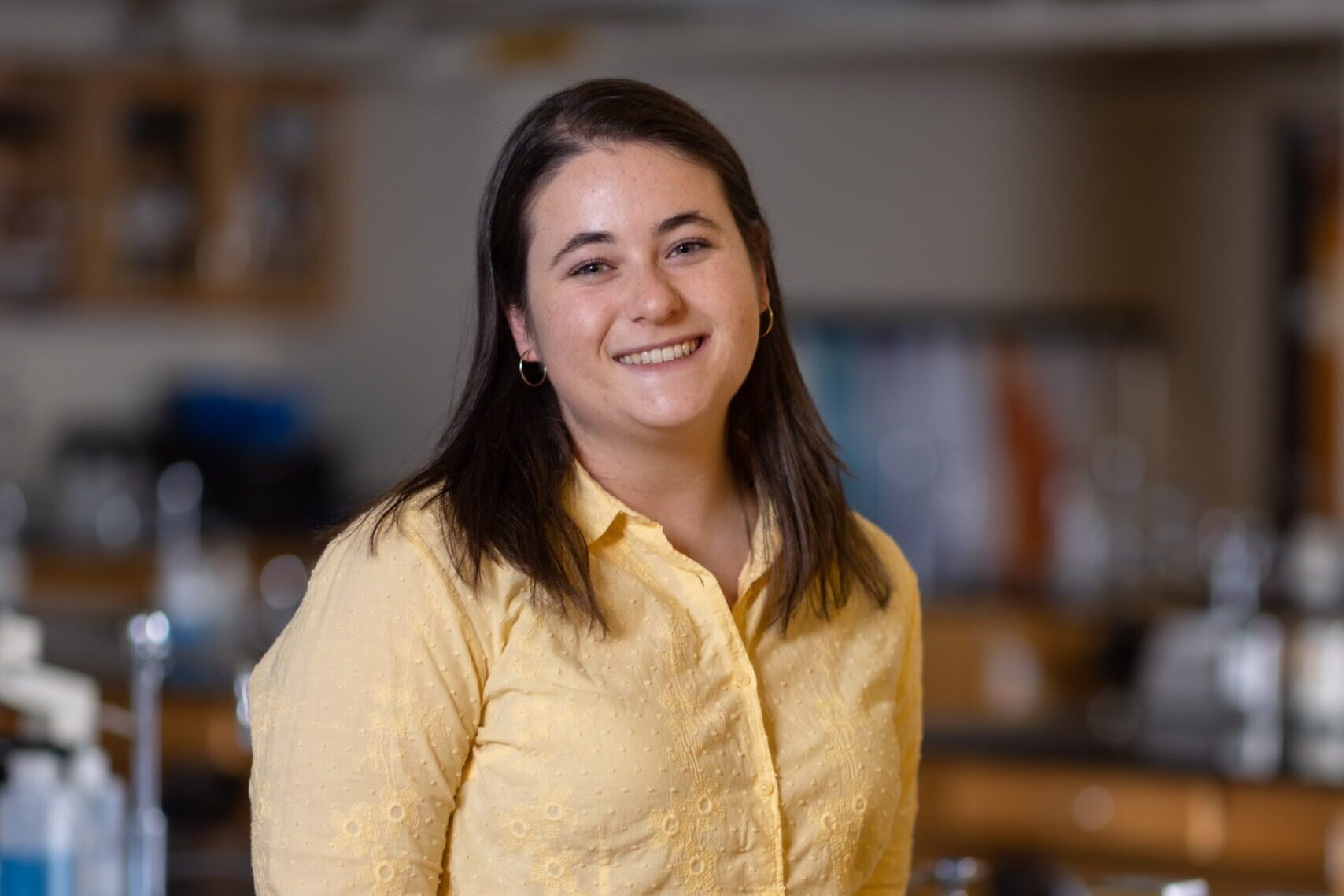
Beth did her research at the G.H. Gordon Biological Station and on campus. Courtesy | Beth Potwardowski
What was your research project?
My research was on stream ecology— I was specifically continuing the work that a couple of other graduates had done where they were testing the relative abundance and the other physical composition of streams within three different types of habitats. There’s a creek called Fairbanks Creek, which is pretty popular for research because it’s one of the only undisturbed streams in Michigan. So all the data that’s collected there sets a good baseline. What I specifically did was a wide variety of sampling methods, just figuring out what factors could impact the abundance of five different feeding groups. My results were similar to data from previous years I’d seen, so it’s pretty encouraging.
What is the practical application of your research?
I think it can apply to evaluating the water quality in Michigan. Typically healthy streams will have a specific relative abundance of those five insect feeding groups, so if you notice that one group is completely gone, or that the relative abundances are slightly different, that leaves an indicator that there’s other environmental pressures affecting those organisms. I think that that definitely is worth monitoring for conservation efforts and also just to maintain water quality as well. That’s a big deal in Michigan.
You were studying bugs. Did you work with Dr. Houghton?
I’d actually worked for him as a research assistant, the previous summer, on the research project that I ended up taking over. That was incredibly helpful just because it helped me learn a lot of the techniques and processes that I’d have to use. He was awesome as a research adviser and mentor. He really is in his element up there at the bio station. We had a great time.
What was it like presenting your research?
I presented it first over the summer at the Michigan Entomological Society Conference and that was fun. It was a little stressful because I decided to do it at the last minute and I was still in the process of collecting data. I’d be collecting data on Monday that I was trying to analyze and fit together into a presentation for Thursday. I got some good feedback for ways to modify it and especially to work on explaining some of the more conceptually dense ideas within the project in a more nuanced way to the average Hillsdale student.
What’s next for you?
I’m actually going to podiatry school, which is very different from the work that I was doing over the summer. I’m very grateful for the research process because I initially thought about maybe doing that type of career path, but I think through the research experience, I realized that while I do really enjoy the outdoors, and I have great respect and appreciation for it, it’s something that I would rather enjoy as a hobby rather than as a professional career.
Dr. Hamilton pitched the idea of podiatry, so I ended up shadowing one over fall break a couple of times. It just really clicked for me. It was something I can really see myself doing for several decades of my life. I also know that a lot of the lessons I learned, especially with patience, persistence, and leaning on your deeper support, will be very helpful to anything that I do in the future.
How do you think your experience in the Hillsdale science department has prepared you for your future?
The science instruction here is very personalized and there’s a lot of encouragement and mentorship from advisers as well.
Even though I didn’t decide to do the sciences until I was halfway through my Hillsdale education, after working in the bio station for a summer I think that kind of sealed the deal for me that I wanted to do biology. I was initially worried that I wouldn’t be able to get everything done or that I wouldn’t graduate on time, but it was great to have a lot of professors who just kind of could help me through the adjustments and figuring out also how to do more independent work. I think sciences are definitely a lot more self-guided and you have to really understand and master the concepts yourself. In a way you have to teach yourself what you’re doing, which is very different from doing your readings and writing papers.
Why should non-science majors at Hillsdale care about science?
Science isn’t this scary thing that people should be afraid of, especially if you’re just a regular person going through the liberal arts at Hillsdale. You still have to take the baby science classes. Hopefully, doing these kinds of interviews in The Collegian will help people realize that science is very special but is also a very different way of being able to understand and appreciate the world.
It is incredible now just to see things in everyday life and know the workings behind them. It definitely gives me a greater appreciation of God and everything that he orchestrated to make our world and our lives possible. That’s something I definitely would not have without a lot of this scientific understanding.
