
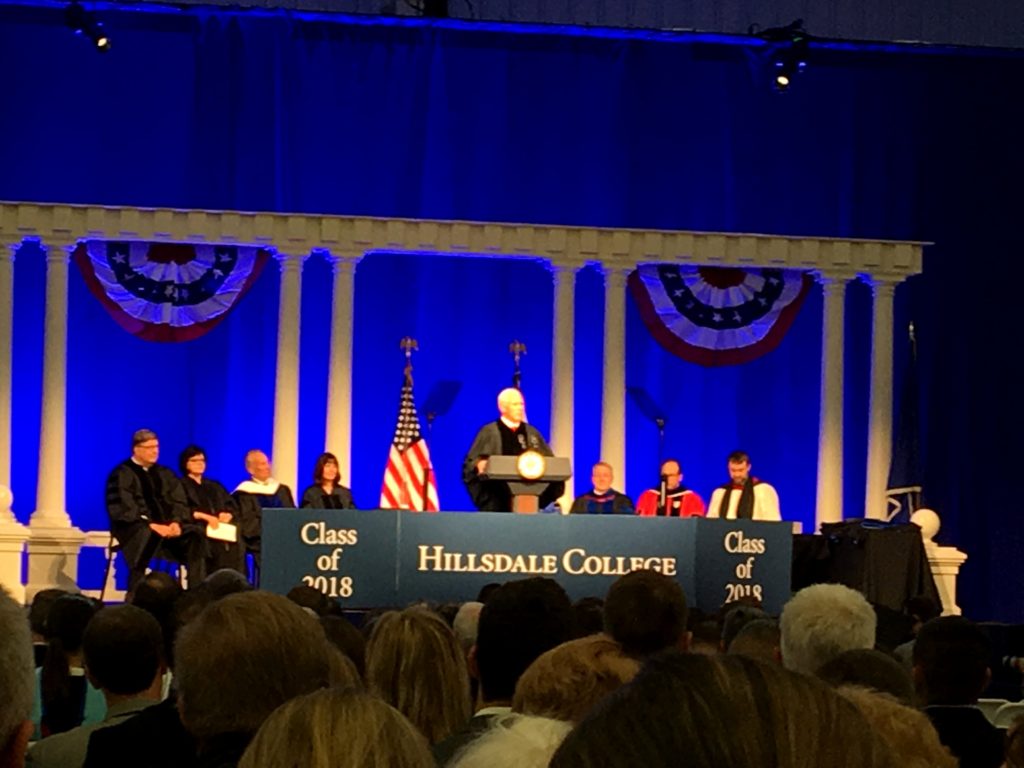
Hillsdale seniors don’t need to invite a commencement speaker. Instead, they should speak for themselves.
Many students think of their graduation ceremony as the end of their time in college. It comes after they’ve completed their courses, packed their things, and prepared to say goodbye to their friends. So it’s surprising that the official term for the ceremony—“commencement”—is defined as “a beginning or start.” Nevertheless, the name was chosen for good reason.
Commencement ceremonies have been around for centuries. Harvard University held its first commencement in 1642. It originally served as a way to welcome graduates into an upper echelon of academia. Graduation marked the beginning for students of a new intellectual life, one where they enjoyed closer proximity to professors and other learned people. In the early days of commencement, speakers comprised members of the graduating class who gave speeches to demonstrate their oratory competence and mastery of languages such as Greek, Hebrew, and Latin. Students sometimes participated in formal philosophical debates called disputations. Regardless of the specific content, commencement speeches allowed graduates to demonstrate the skills they’d developed during their years at college. Guest speakers occasionally contributed to commencement ceremonies alongside students but were not considered the primary speakers.
As time passed, the importance of oration and classical languages in college education diminished, and guest speakers began to replace student speakers. It is now standard practice for colleges to invite well-known artists, politicians, and entrepreneurs to deliver commencement speeches in lieu of students. Barack Obama, David Foster Wallace, and Steve Jobs are among the most famous commencement speakers in recent history.
Hillsdale should subvert this trend and return to the tradition of entrusting students with commencement addresses. They should revive the practice of having students deliver the speech in a classical language and engage in philosophical debate. There is no one better equipped to deliver a commencement speech to the Class of 2023 than one of its own members.
A commencement address given by a students would better adheres to the original intent of commencement. Graduating students have spent the past four years listening to and learning from gifted speakers in the classroom, and they’ve done so partly in accordance with an academic hierarchy that designates professors as speakers and students as listeners. There is no better way to signify the softening of those boundaries than by allowing students to take the mic and demonstrate their gifts with an attentive audience of their own. A tradition like this would help convey the privileges and responsibilities the graduates take on as they enter this new phase of their life.
A student-delivered commencement address would align with Hillsdale’s commitment to classical education. It would bind our traditions to those of great universities of the past while reasserting the importance of oration, classical language, and philosophical debate in the modern world.
It would also be consistent with Hillsdale’s emphasis on community and self-governance. Rather than asking an outsider to deliver such a meaningful address, students could decide among themselves who is best suited to speak. The ceremony would celebrate the accomplishments of the graduating class rather than those of a speaker unaffiliated with them. Rather than looking outward to find brilliance, the Hillsdale study body would look inward.
The senior student body president already delivers a speech at commencement. Although it isn’t the main attraction, it shows that hosting student speakers at the event is a viable idea.
Additionally, watching graduates show off their skills would be more interesting than listening to a speech delivered by a stranger. It’s always a joy to see people you care for do something they’re good at and passionate about. Allowing the student body to get together and watch fellow students take on the task of delivering such an important speech would foster an environment of support and appreciation.
Watching a famous person give an address isn’t the once-in-a-lifetime opportunity it once was. The ubiquity of the internet means that more and more people have unprecedented access to any given speaker’s body of work, meaning that commencement speeches garner less enthusiasm than they once did. Hillsdale should try something different by returning to the roots of commencement and giving students the opportunity to represent themselves.