
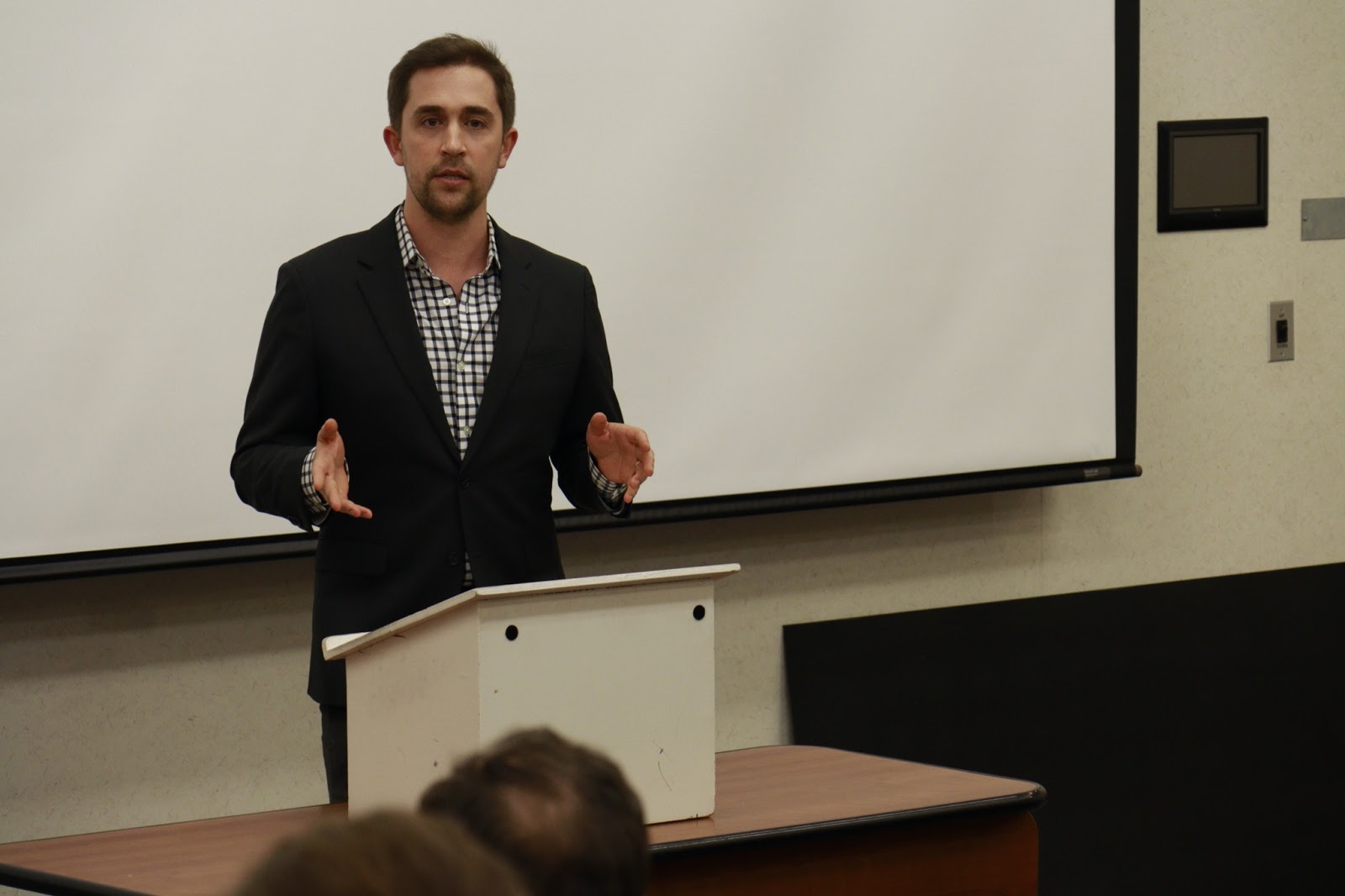
The best solution for defeating the Marxist-Leninist ideologies within institutions today is to lay siege to them and create alternatives, said Christopher Rufo at a lecture on Tuesday.
Rufo is a senior fellow and director of the initiative on critical race theory at the Manhattan Institute. He is also a contributing editor at City Journal and this semester’s Pulliam Fellow in Journalism.
Rufo began by giving context for the radical ideologies present today which began in the year 1968.
“If you look at 1968, it was really a turning point — a paradoxical, and contradictory turning point in American history,” he said. “You had all of the left wing ideologies that seem so dominant in our institution today being born in the months in and around 1968. It’s almost as if we’re living in a permanent repeat of some of those ideas.”
Radicals realized that revolution in its traditional form, such as assassinating police officers in New York City, would no longer be effective.
“The lesson that they learned at the time was that the working class in Western Europe, and most especially in the United States, could not be roused to revolution. Americans were not only non-revolutionary — they were anti-revolutionary,” he said.
Rufo said Americans became content with the higher forms of living foreign to previous generations.
“These radicals formulated a more sophisticated and frankly, successful strategy of abandoning hope that the lumping proletarians and the outcasts of society could be a part of this revolution,” he said. “They said we’re going to have a revolution of intelligentsia, a revolution in elites by seizing control not through the means of production, but through the means of culture and knowledge production.”
As a result, the radicals entered their Marxist ideas into institutions of all areas of education, such as the federal government, K-12 schools, and universities.
“You’re taking the core concepts that were developed in that period after 1968,” Rufo said. “They’ve been sanitized, adapted, repackaged, and repurposed, and then injected into American life at the lateral bureaucratic and institutional level.”
To illustrate his point, Rufo gave the example of white privilege where institutions brainwash children as young as ages 7-9 years old to comply with this ideology.
“Children in the classroom can be separated into oppressor and oppressed based on identity categories based on skin color and then deemed oppressor and oppressed,” Rufo said.
He said a school in Cupertino, California, required white children to atone for their white privilege, methods influenced by the Marxist-Leninist theory in 1968.
“The idea is that you’d have to break down the working class notions of white privilege in order for them to join the Marxist revolution,” Rufo said. “The purpose and origin of a lot of these ideas as you go down the line, all emerges from that point, and now has been transferred through academic literature, through K-12 pedagogy, through master’s and education programs, and human resources’ departments at corporations.”
Rufo continued to address the problem, saying this language is one of obscurity, euphemism, and demoralization. He said the system was constructed to be impenetrable in order to be successful.
Through his reporting, Rufo has tried to discover the meaning behind the language of these ideologies.
“The HR training at Walmart is the same as the fifth grade education module in Buffalo public schools which is the same as the trained diversity and inclusion training program at the Department of the Treasury in Washington, D.C.,” he said.
The revolution, which started in 1968, seeks to dissolve the individual through group identity.
After addressing the problem, Rufo offered a response of “tactics and strategy.”
Before introducing tactics, Rufo discussed the recent Disney scandal he broke on March 29.
Rufo said Disney employees sent him leaked, internal videos that allowed him to break the news of Disney’s agenda to indoctrinate children with its own ideas of sexuality.
“If you want to keep your job, you have to shut up,” he said, describing the employee environment at Disney regarding sexuality. “These things get deleted temporarily, but they always resurface.”
Disney’s plan to indoctrinate children was a response to Gov. Ron DeSantis’ recent bill keeping sexual orientation and other related topics out of the classroom between the ages of kindergarten and third grade in Florida.
Rufo said Disney believed it had the right to be the children’s moral voice on topics of sexuality.
“It wanted to not only oppose the legislation, but use all of the levers of corporate power to fundamentally reshape the narrative about kids and sexuality,” he said.
Rufo said in order to defeat institutions like Disney, people need to look at their records. In his reporting, Rufo showed that Disney had a pattern of sexual crimes in its history including repeated abuses on children at its amusement park and an abuse aboard a Disney cruise ship.
“The lesson of this is that the institutions in the United States that have adopted these strategies cannot be appeased,” Rufo said.
In response, Rufo offered two strategies: take on the support of the public and mobilize public support.
“These institutions don’t choose these ideologies democratically,” Rufo said. “You didn’t vote for it. I didn’t vote for it.”
Rufo advised parents to take action in fighting institutions. Through mobilizing public support, parents can have an effective outcome. He gave overwhelming numbers of parents successfully winning campaigns or overriding school board programs.
“Unless parents are given more power, more freedom, more options, and more choice, they’re going to be forced to run their kids through the gauntlet they can’t control,” he said.
Rufo said people need to reveal the evils within these institutions which try to destroy people’s lives through vague, seductive language.
“We really have an option between the revolution of 1776 or the revolution of 1968,” Rufo said. “One of them offers an incredible unfolding of those founding principles of freedom and equality. The other ends in nihilism, despair and demoralization.”
Senior Gabriel Powell expressed his appreciation for Rufo’s perspective.
“He very much articulated the point of view that is lacking on the right,” he said. “Why spend all this money when we have a 2:1 issue on this? And yet, so many legislatures have not even thought about that we have a 2:1 ratio and we could use this to take away funding and change policy with this.”
Assistant Director of Student and Young Alumni Programs Braden VanDyke also commented on Rufo’s new approach.
“To have someone like him who has created his own lane within journalism and own field of expertise was really new and neat to see,” VanDyke said. “If he can do it, then we can too. We are not as decentralized as the government would like us to think we are.”
