
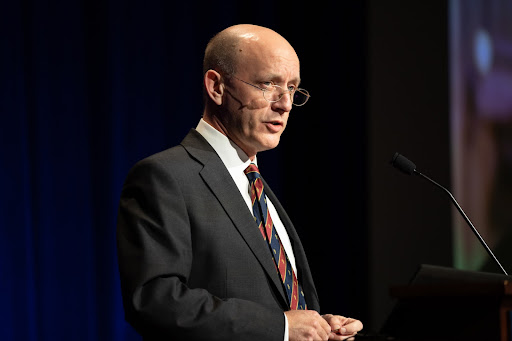
Hillsdale’s newest Visiting Fellow traveled nearly 4,000 miles from Oxford, England to Hillsdale last weekend.
Michael Ward, senior research fellow at Oxford University, a Catholic priest, and a C.S. Lewis scholar, spoke at CCA III: The Inklings on Sunday, Jan. 30 about his most recent book, “After Humanity: A Guide to C.S. Lewis’ ‘Abolition of Man.’”
When did you first read “The Chronicles of Narnia?”
Well I’m not sure. “The Chronicles of Narnia” were read to me by my parents before I ever read them to myself. One of my earliest memories is my two brothers and I jumping into our parents bed on a Sunday morning and my mom reading a chapter or two of the latest Narnia. book And we would all get up and have breakfast and go off to church. It was quite a routine for us.
Which character in “The Chronicles of Narnia” would you say you’re most like? Which character do you like the most?
I’m tempted to be frivolous and say the Bulgy Bears who suck their paws. And who am I most like? Well, probably Digory Kirke, as I am a professor.
What’s the real order of “The Chronicles of Narnia?”
The real reading order for first time readers is undoubtedly, unquestionably, starting with “The Lion, The Witch, and The Wardrobe,” not “The Magician’s Nephew.” The really key thing is not to start out with your first exposure to Narnia being “The Magician’s Nephew.”
It’s not the first book and there’s no way it can be understood as the first book. I wish the publishers would stop misleading the reading public by putting a number “1” on “The Magician’s Nephew.” It should be illegal. There’s no way it should be read first.
What is C.S. Lewis’s most underrated book?
“Miracles.” It’s quite difficult, and people get a bit bogged down. In fact, that’s what happened on my first read. It’s the only book that I did not complete on the first attempt. The opening half is quite outgoing. It’s also underrated because it’s immensely rich and full of good stuff. It’s quite a serious work. Not quite like “Mere Christianity” or even “Reflections on the Psalms” or “The Screwtape Letters,” which all have a sort of populist or popular edge to them. “Miracles” is quite meaty, but I think that’s really, really good. The second half is outstandingly good.
You had a small part in “The World Is Not Enough,” the James Bond movie. How did that happen?
I started out my career, if you want to call it that, as a film extra. I was in the film “Shadowlands” when it was made in 1993 in Oxford. This agency rang me up every four to six months to be an extra. So I did five days here or there for several years in lots of interesting films, including Kenneth Branagh’s “Hamlet” and episodes of “Inspector Morse.” Then one day they rang me up and said ‘Do you want to be in the James Bond film?’ And obviously, I said yes, thinking I would just be involved in a crowd scene, like you normally are, except I was not in a crowd scene. I was in a scene with three other people, including James Bond himself. Probably the reason they cast me in James Bond was because I was bald and wore spectacles. My baldness served me well in the James Bond movie.
When you were a kid, what did you want to be when you grew up?
Well, when I was 5 I wanted to be a pet shop owner, like many kids who liked animals. But as early as I had a serious notion, it had been writing and I suppose being a priest.
What is one of the biggest misconceptions of Oxford?
The biggest misconception of Oxford is probably that everyone there is a genius. There are every year in each cohort one or two geniuses, extraordinary people. But the rest of us could easily be replaced by a number of students at any other university. Some people think it’s for posh people, and that’s a misconception, too. I remember my first week of Oxford. I went to the college chapel and the priest there was preaching, and he said that exact thing: “One or two of you are geniuses, and the rest of us are all very normal, it’s largely by luck that we’re here.” It was very humbling and realistic.
What are your career goals?
My goal is to continue writing. My latest book is “After Humanity: A Guide to C.S. Lewis’ ‘Abolition of Man.’” It was published last year. I’m also working on a book about C.S. Lewis as an evangelist, and a book of film reviews, which will be called “Popcorn with the Pope.” It would be nice to branch out into fiction and drama, not just nonfiction. I suppose that’s at least a goal or hope. Another hope or a dream is that I would like to get around all 50 states. I’m up to nearly 40, and only have about 10 or 12 left, including Alaska, the two Dakotas, Maine, Vermont, New Mexico, and Arizona.
What’s your continuing role at Hillsdale?
I’ll be back to teach a short class in March, and then September. And now that I’m a Visiting Fellow I’ll be coming once a year. It will largely be the same course every year. I was told just today that 55 students applied to be in the course in March, and only 15 can take it. But if I come every year, hopefully everyone that wants to can take it.
