
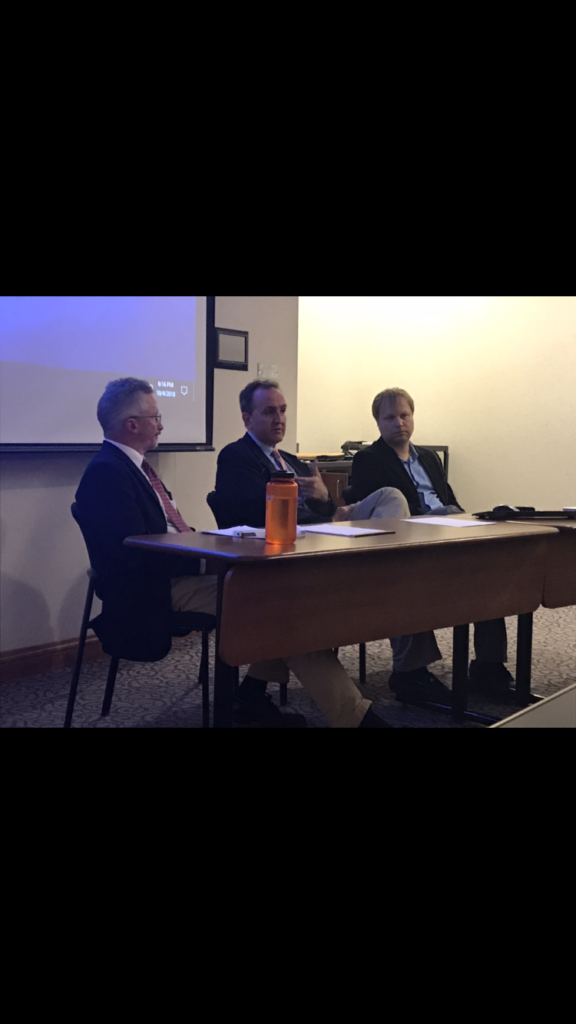
Hillsdale students reached for the stars as they listened to a panel of faculty discuss the future of space.
The Alexander Society hosted a panel of professors from various academic departments to discuss the newest military branch — the Space Force. Professors speaking were Associate Professor of Economics Charles Steele, Assistant Professor of Physics Timothy Dolch, and Paul Moreno, professor of history and dean of the social sciences. Each spoke for 10 minutes about their disciplinary perspective on the creation of the Space Force, and then the panel answered questions from the audience.
“I never knew what the implications of the Space Force would look like,” freshman Morgan Billingsley said.“I wanted to see what three more learned people had to say.”
President Donald Trump proposed the establishment of the United States Space Force as the sixth branch of the military on June 18 of this year. The current plan is to create the proposed service by 2020.
Though from different disciplines, the panel agreed that the development of the Space Force is an appropriate and fitting decision; however, they expressed different reasons for supporting their belief.
Steele chose to focus on the potential economic development of space and militarization beyond earth.
“Below earth’s orbit—the space between here and the moon—is military high ground, and it’s going to be occupied,” Steele said.
He said there is already an economy in space, and if the United States does not advance in space, someone else will.
“Space is already militarized,” Steele said. “And I think it is inevitable.”
Steele also referred to the Soviet Union and their long-running efforts in space as well as the Russian Space Force. He compared the conquest of space to the European efforts at sea in the 17th century.
Steele said a decentralized market approach to space works well if there is a physically defined goal such as going to the moon.
“If you’re trying to maximize consumer value, then you need something that is more market based,” Steele said. “That’s the direction we’ve been moving.”
Steele also said in order for development to happen, the space economy will be based on exclusive property rights.
“The reality is that we will see a trillion dollar space economy,” Steele said.
He focused on the history of space development and made the claim that the Space Force, as a general concept, is nothing new. He noted how space technology developed after World War II, specifically with the space race that led to the development of going to the moon during the Kennedy administration.
“There has always been this close relationship between the military and space exploration of various kinds,” Steele said.
Dolch noted that a major motivation for the Space Force is to have a space-based tracking and defense system that would defend against the sort of weapons that come out of space to earth. Dolch said the biggest reason for Space Force is to defend satellites.
“One of the reasons of now for increasing military activity in space, is utterly dependent on the GPS system which is a global networking system,” Dolch said. “If a foreign adversary took out a network of these satellites, we would be utterly crippled.”
Moreno said the militarization of space is inevitable.
“The human record is almost 100 percent certain that there will be militarization wherever human beings can militarize things,” Moreno said.
Sophomore Philip Andrews said he had some important takeaways from the panel.
“I agreed that space will keep expanding, and I think it should keep expanding,” Andrews said. He added that he is curious to see how recruitment will work for the Space Force and who will join.
Moreno said the history of humanity has led to the militarization of space.
“Something in human nature guides us to space,” Moreno said. “Human societies will stop at nothing when they think their survival is at stake.”
