
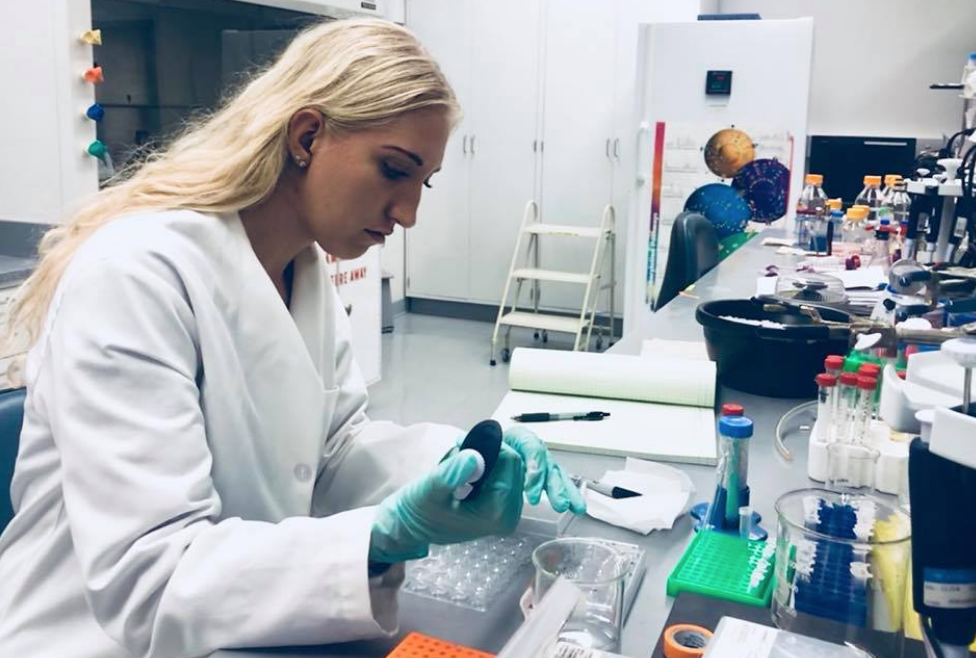
Over the summer, senior Natalie Meckel was admitted to a research program, spending the summer crystallizing proteins for neutron diffraction experiments at the University of Nebraska-Lincoln to take part in the 10-week Redox Biology Center Summer Research (REU) Program.
“I’d planned on doing research ever since I was a freshman as part of my biochemistry major,” Meckel said. “There were a ton of possibilities in the Redox Biology Center.”
Her research focused on structural biology regarding human DJ-1, a protein that plays a significant role in Parkinson’s Disease. Meckel explained that “familial Parkinson’s disease is caused by mutations in the human genome, a collection of which destabilize human DJ-1 and impair its function.”
According to Meckel, this is what makes human DJ-1 of interest in factors leading to the neurodegenerative disease. Although it is known what causes this in familial Parkinson’s disease, it is unknown what the cause is of sporadic Parkinson’s disease.
“In order for us to understand exactly how DJ-1 plays a role in sporadic Parkinson’s Disease, we need to understand what other factors might lead it to be deactivated besides mutation,” Meckel said.
She said understanding the “structural nuances of DJ-1 will help us determine what environmental factors cause it to be destabilized,” and that is why the hydrogen bonds in the protein are key components to study. Meckel’s research concentrated on developing a crystallization procedure for the protein. If the crystals are large enough, they can be used for neutron diffraction experiments to locate the hydrogen bonds. These experiments are only possible with a nuclear reactor.
“You actually shoot neutrons at it, and the neutrons bounce off of molecules based on their nuclei,” Meckel said. “Hydrogens are really sensitive to this type of experiment.”
In the experiment, it is important to localize hydrogen bonds because “current models predict several key hydrogen bonds” surrounding an amino acid called Cysteine 106, she explained. Cysteine 106 is critical to DJ-1’s activity, and “factors that might affect its reactivity, such as nearby hydrogen bonds, likely have a role in the cause of Parkinson’s.”
“That’s why the whole goal of my procedure was making crystals that would enable us to localize hydrogen bonds,” Meckel said. “If we were able to totally understand what causes DJ-1 to be disabled or inactivated in people with Parkinson’s, we could work on constructing a pharmaceutical that would possibly prevent that from happening.”
Meckel’s crystallization procedure that would allow researchers to perform the experiment and locate the hydrogen bonds was simple but delicate. She expressed the protein in E. coli bacteria and purified the protein for crystallization experiments.
After the protein was concentrated, she placed a tiny drop of oil in a well of a plastic tray, and on the bed of the oil, she put tiny drops of polyethylene glycol, a solution known to cause a protein to precipitate into a solid. Using a cat whisker, she put miniscule amounts of crushed up protein crystal on each drop.
“By varying the type of oil and the concentrations of protein, polyethylene glycol, and crushed crystals called microseeds, I optimized the procedure to produce large tetragonal crystals,” Meckel said.
Dean of the Natural Sciences Christopher VanOrman, Meckel’s junior research adviser who reviewed her junior thesis on the role of DJ-1 in Parkinson’s, said Meckel had been interested in the DJ-1 protein the year before, and she was well prepared to do this type of biochemistry research.
“Natalie excels in critical thinking, quantitative reasoning, scientific inquiry, and her written communication,” VanOrman said. “She is one of our best and brightest students.”
Assistant Professor of Chemistry and Meckel’s academic adviser Courtney Meyet agreed, saying that Natalie has been a teaching assistant for her this year and last year.
“Natalie is approachable and has a positive attitude,” Meyet said. “It is no doubt these attributes served her well during research.”
