
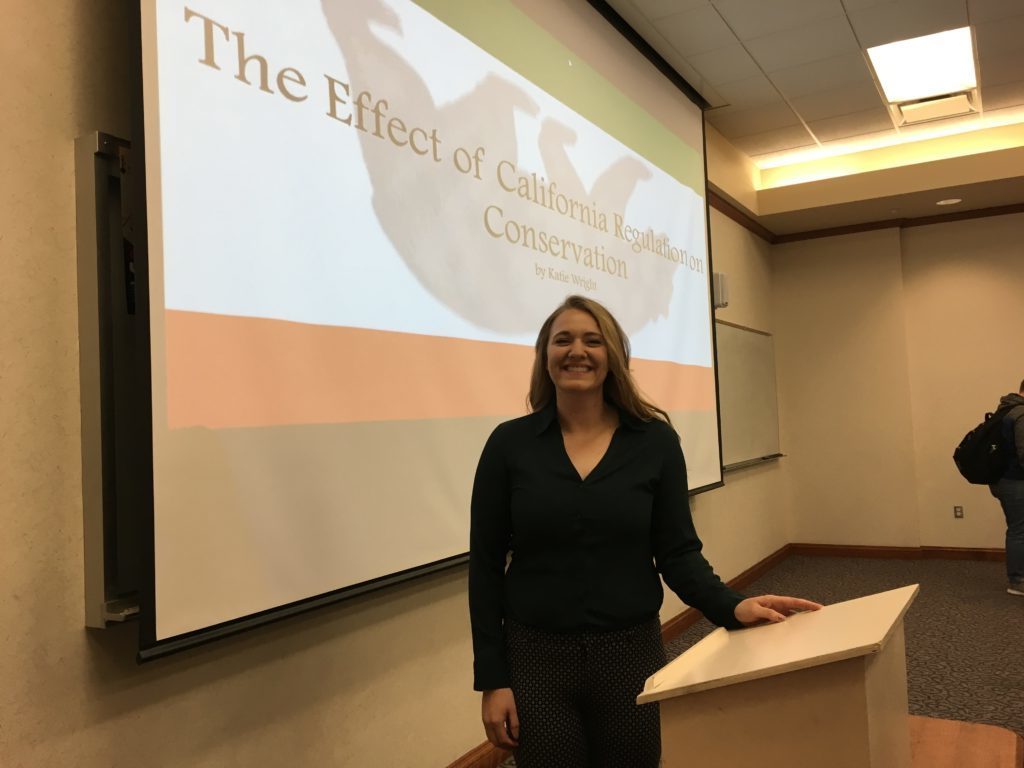
Too often, governmental regulation forces a decision between the environment and the economy — but that doesn’t have to be the case, according to senior Katie Wright, who gave a lecture about California’s water regulation system March 29.
Wright said the environment is considered a public good, since one person’s consumption doesn’t affect another’s consumption.
“After all, if you don’t use it now, someone else will,” Wright said. “Even if your intention is to conserve, your efforts could be cancelled out by someone else.”
In the Eastern United States, where water is plentiful, landowners are given water rights, but they don’t own the water itself.
“That approach would be problematic for states like California, where any water use necessarily means that someone else is getting less,” Wright said. “This is why a different system evolved in the Western United States.”
Instead, California uses a priority-based system that developed during the influx of miners during the California Gold Rush.
“It is assumed that users will have access to different amounts of water during times of drought, and consequently, the issue that needs to be addressed is who gets the water, not how much,” Wright said.
California’s use of prior appropriation, however, creates a problem of free-riding, which occurs when someone else can take part in a costly activity without having to pay the price, Wright said. She compared the problem of free-riding to borrowing swipes from a friend’s larger meal plan.
“Rivalrous users have an incentive to free-ride off of non-rivalrous users, and it just so happens that non-rivalrous uses oftentimes promote conservation,” Wright said. “This does not incentivize environmental users to purchase a water share.”
In California, the state currently uses a blend of prior appropriation and the command and control approach in which the state owns water rights and the California water board issues regulations.
“Embedded in this approach is the assumption that only governments and experts know how to ration water effectively,” Wright said. “If left up to the individuals, the only outcome would be unfair and detrimental to the environment. Consequently, the government intervenes to ration the water.”
Economically, a lot is at stake during a drought. Reed Watson, executive director at the Property and Environment Research Center, estimated $900 million dollars were lost in crop revenues, $590 million in increased groundwater pumping costs, $350 million lost in dairy and livestock revenue, and more than 10,000 seasonal jobs were lost.
“The implication of environmental scarcity reveals itself in our economy,” Wright said. “If this connection is so strong, why is it that legislation, especially in California, choose one without considering the other?”
She cited California’s almond subsidies as an example of a regulation that encouraged the growth of a water-intensive crop.
Wright said that since farmers must put their water to beneficial use in order to maintain their claim, conserving water is discouraged under the current system.
“If farmers implement technology that conserves water, they’re not using their full water right and it could be taken away,” Wright said. “The result is that wasteful behavior is not mitigated, it is encouraged… Through intervention, California provides environmental quality as a public good, and doesn’t charge citizens directly for protection of the environment.”
As a result, individuals don’t realize the true cost of conservation and its value. As an alternative to the current system, Wright said water markets would promote water conservation — a system she said has demonstrated success in Australia.
“In water markets, shareholders can freely trade and barter based on current scarcity,” Wright said. “Governments and nonprofits could purchase shares for municipal or environmental reasons, but they would be required to pay a price like everyone else… No matter the environmental circumstance, shareholders receive compensation for their takings.”
Wright said that this system promotes conservation of water since it becomes the most cost-effective practice.
“Price may have motivated his decision, but conservation was the result,” she said.
Wright also suggested the institution of water judges who can allow for efficient transfers of water shares between different parties — a more efficient alternative to California’s current bureaucratic transfer process. Transferable property rights allow people to exchange their shares when they are most valuable, thereby promoting water conservation, Wright said.
Conservation Club President senior Andrea Wallace said Wright’s presentation shed light on how real steps can be made to help conserve natural resources.
“After hearing her talk last year on the privatization of endangered species, we really knew that we wanted her to give a talk for Conservation Club,” Wallace said. “Water conservation is a really important topic with very real implications.”
