
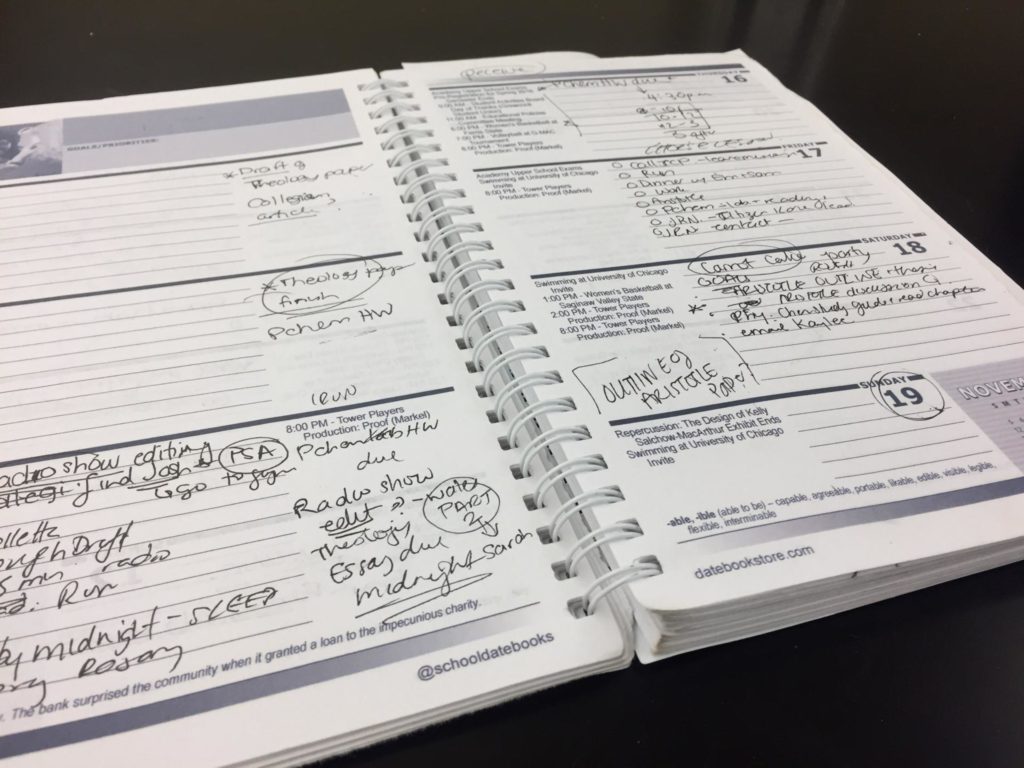
One of the habits that I’ve wrestled with over my college years is keeping a planner.
I’ve tried the online Google Calendar, the Hillsdale student planner, a fancy store-bought planner, and opting for the planner-less lifestyle – liberating, yes, but overwhelming in a week of studying for three tests, making Collegian article deadlines, and taking equestrian lessons, all while trying to keep track of seven meal dates.
The planner-less lifestyle is especially unsustainable as the end of the semester nears, so I began to wonder, what is the easier habit to keep – electronic or a paper planner? I asked my professors.
Professor of biology Dan York patiently endures the lifeless body of students in my 8 a.m. human anatomy and physiology class, and with a Southern twang, widens our drooping eyes with stories of his time a snake wrangler in Africa. With his clear-rimmed plastic glasses and preppy color-coordinated sweaters and neckties, York is an image of graceful aging; he’s approaching year 18 as a Hillsdale professor.
“I use technology to try and beat my procrastination,” York said, sitting behind his 21.5 inch iMac desktop computer in his office. “I have a calendar in Outlook with due dates that gives me warnings and ‘bug-me’s,’ otherwise I’m too unorganized.”
York still remembers his first computer, one of the first Macintosh models.
“It was a skinny iMac without a hard drive. Gosh, I loved that thing,” York said. “I had it in the 1970s and used it to make my undergraduate work as efficient as possible.”
Moving up from the biology floor in Strosacker, I asked my academic advisor Lee Ann Baron, a professor of chemistry, for her vote on electronic versus paper planners. As any Hillsdale science student will tell you, Baron is a treasure of practical wisdom that never stops giving. Literally. I’ve often continued a conversation with Baron down the hallway as I’m running to class because she has one more thought to share.
On the topic of organization, Baron said she preferred paper planners, and followed up with more advice on habit formation for technology use.
“Students should turn off their phones in 50-minute increments when they study,” Baron said. “Research has shown that maximum concentration occurs for 50 minutes at a time.”
I left her office with a new resolve to monitor my screen time.
York and Baron left me with a tie on the question of electronic versus paper planners, which proved that I was asking the wrong question. Habit formation doesn’t start from looking for what’s easier, but from being committed.
So I took out my Hillsdale planner that evening and I began forming a new habit.
