
Pursed-lip breathing may be the solution to surviving hell week stress.
The psychology department recently installed new technology that helps students learn how to control their stress.
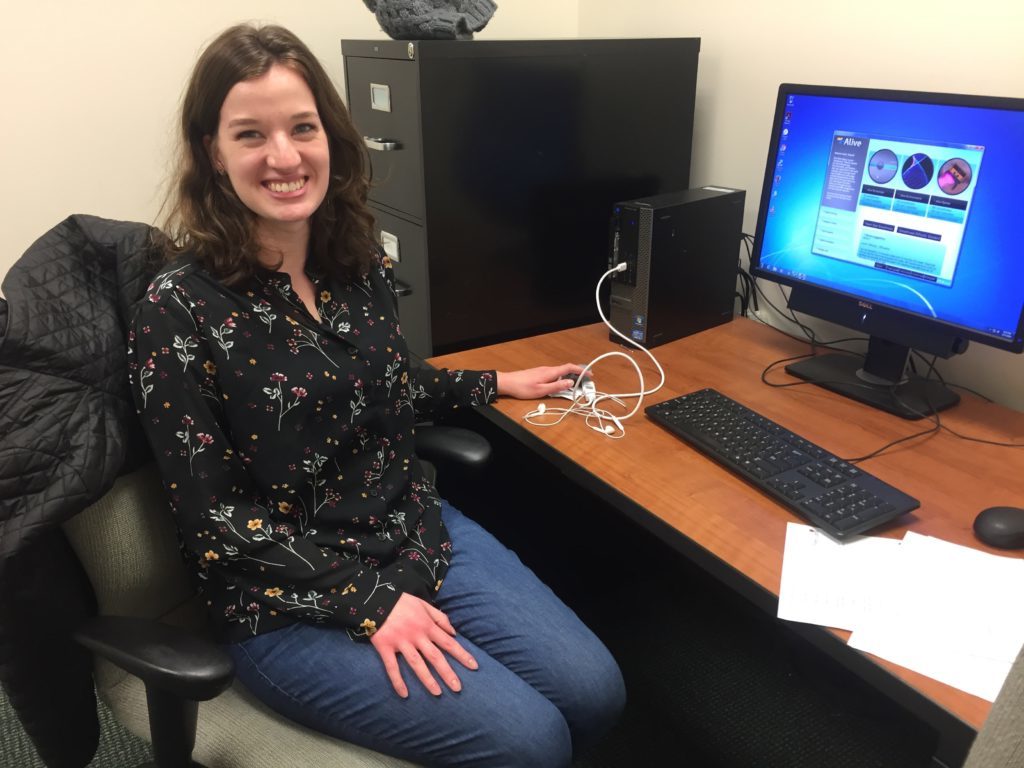
The technology, a combination of a noninvasive sensors and computer software that reads the sensors’ data, was originally brought to the school for undergraduate research. Now, it is available for students, faculty, and staff to use in a project called the iFeel Alive Labs.
Psychology department chairwoman Kari McArthur said a sale on software and sensors allowed the department to purchase five sets.
“I had used these sensors in my classes and got really positive responses, so I started thinking it might be a really good idea to open up our labs to other people who might be interested,” McArthur said. “It’s also a good time of the year to do so.”
This biofeedback technology enables the student to see his or her own stress levels on the screen, and by practicing breathing techniques and playing games, they can learn how to control the smoothness or consistency of their heart rate.
The bluetooth sensor, worn on the finger, measures the physiological responses of the body to stressful situations, such as heart rate, and sweat gland activity — responses that students usually cannot detect in themselves.
The software corresponds with the stress level of the students: If their heart rate is uneven, the screen might get darker or the car they are racing will slow down. If, however, by implementing breathing techniques they are able to smooth out their heart rate, the game progresses.
McArthur said her students combined the names of the software, Alive Pioneer, and the sensors, which are from iFeel Labs, to create the name for the project, “iFeel Alive.”
Sophomore Lab Assistant Sydney San Juan said this kind of equipment is more advanced than some of the other biofeedback technology the psychology department has used in the past.
“This technology is not cheap,” San Juan said. “It’s typically used in a clinical setting for someone who is having anxiety, to help them understand their stress in a different way. We’re obviously not clinicians, and this isn’t an alternative to that, but I think it’s cool that we get to use this technology that clearly helps in some way.”
Freshman Lab Assistant Olivia Manocchio said the sensors can train students to control even minor stresses they did not realize they had.
“I didn’t realize how uneven my breath actually was until I utilized the equipment, and was able to see it. You can’t get that mental training by just reading about the techniques online,” Manocchio said.
The equipment is not, however, a substitute for clinical treatment of anxiety, McArthur said.
“I want to make sure that people know,this is not a substitute for any mental health services. If any students, faculty or staff have any anxiety in their lives, I recommend that they contact the Ambler Health and Wellness Center on campus or their own mental health provider,” she said.
McArthur also pointed out that one 30-minute session will not make a drastic change.
“This is not a one-time deal. Maybe you’ll learn a little bit on your first session, but it’s not designed to be a one-time fix. The more you come in, the more you learn, the greater help it’s going to be,” she said.
Nevertheless, students have said they already noticed a difference in how they are able to control their heart rate in stressful situations after only using the equipment a few times.
“I definitely think that it does help reduce stress,” Manocchio said. “I’ve noticed an ability to calm myself down when I am anxious or stressed about something. Given Hillsdale’s high-pressure environment, I think it’s important for students to learn how to manage their stress better. I’ve seen students who are having nervous breakdowns, and getting into some very unhealthy habits, and I think that this would help them find better coping methods.”
Sophomore Erin Gordon, who tried the equipment last week, said different breathing techniques are offered in order to figure out which one works best for the individual.
“They give you several different types of breathing to try, and the pursed-lip breathing worked the best for me to help me slow down my heart rate,” Gordon said.
The iFeel Alive Labs are open for all students, faculty, and staff Monday through Thursday nights from 7-9 p.m. in the Psychology Suite in Kendall Hall until May 8.
Students can sign up ahead of time online for 30-minute sessions through the following link: https://ifeelalive.youcanbook.me.
Since the labs are student-run, McArthur said it is uncertain how long the labs will be open. McArthur said she hopes continue making the equipment available to campus through the upcoming weeks.
