
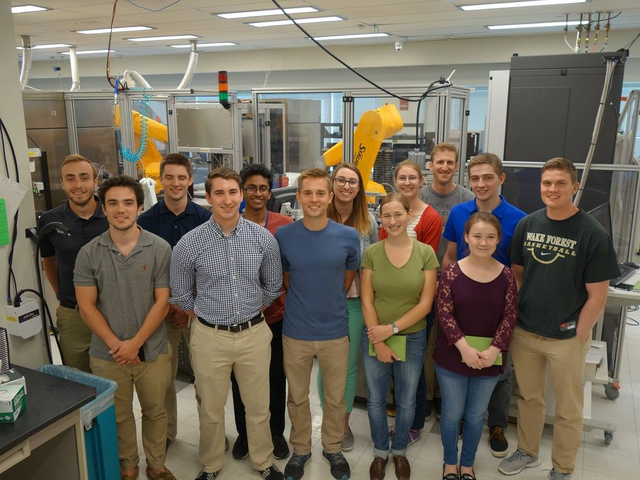
Senior Delaney Lehman spent a summer finding a compound that could be synthesized to cure Charcot-Marie-Tooth disease, a mutation that causes severe handicaps, in her internship with the National Center for Advancing Translational Sciences.
To clarify: This research had nothing to do with sharks, French monarchs, or dental problems.
The incurable disease, which affects 2.8 million people worldwide, causes loss of normal function or sensation, or both, in legs and arms, but is not fatal, according to the Charcot-Marie-Tooth Association.
It is named for the three physicians who first described the symptoms of the disease and discovered the gene mutation it is connected to: peripheral myelin protein-22, which is involved in the development of the myelin cells in the peripheral nervous system.
Since there is no drug treatment available, people with the disease turn to physical therapy, supports, and braces.
It affects any part of the nervous system outside the brain or spinal cord. Since the protein is mutated when this gene is overexpressed, patients experience muscle atrophy, loss of sensation, and loss of proprioception.
Lehman was assigned a collaborative project when she got to Maryland. Since the research was at its beginning stage, she worked with the biologists who designed the experiments, physicians who communicated with patients, and bioinformaticians who programmed a robot to filter the data.
Lehman’s task was to examine and double-check positive test results. She created synthetic organic schemes and troubleshooted various complications that came up over the course of doing the organic synthesis itself. A robot had already done the dirty work — or testing hundreds of thousands of compounds to find any that were positive as inhibitors for the gene peripheral myelin protein-22.
Professor of Chemistry Courtney Meyet illustrated the role of organic chemistry in medical research with an example: One of the biggest recent developments in organic chemistry has been the total synthesis of the molecule taxol, which was first isolated from the bark of a yew tree and is used in cancer treatment.
Instead of trying to harvest all the yew trees and extracting the taxol, chemists can synthesize the molecule in a laboratory. This impacts the environment less and allows them to modify the molecule.
Since this process takes multiple steps, it can be wasteful and unsafe, as it involves toxic chemicals. Organic chemists research ways to shorten the routes to the compound, making it more efficient, less wasteful, and safer.
The research was unsuccessful, which is a common theme in small-molecule research nowadays, Lehman said. While she was able to synthesize the compounds correctly, when the compounds were tested again in the same experiments, none of the compounds looked like inhibitors — signaling it wasn’t a problem with the synthesis but with the original compound. Her adviser at the NIH Diane Luci said this was probably because the molecule had degenerated or was contaminated. The project was actually canceled shortly after she left.
“I think it’s a really tough time to be an organic chemist in drug research, just because it’s so hard to come up with
a new small molecule that is specific enough to just act on DNA of interest, not cause damage to the rest of the body and not have a lot of side effects but be strong enough to do what you want it to do,” Lehman said. “We’ll see if there will be more work done on this in the future. I think there will be a lot more emphasis on RNA and DNA and gene editing.”
According to Meyet, sometimes projects don’t move forward. Of the drugs on the market, millions of potential candidates came before those on the shelves.
“If you think of it like a funnel, and you get down to the end of the project to one or two candidates, it might not be fruitful,” Meyet said.
Amid the synthesis and chemistry, Lehman interviewed people with Charcot-Marie-Tooth Disease and saw how it influenced their lives, why they wanted research to happen, and how successful results would affect them.
She said those interviews were the most interesting and compelling part. She had enjoyed organic chemistry so much that she had questioned that goal, but after her summer of research, it was the interviews that confirmed for her that she should become a doctor.
“I really want to be helping people in a one-on-one situation,” she said, “as opposed to developing a drug, which, sure, is really good and — if it works out — is going to help a bunch of people, but I like coming to understand people for who they are rather than being helpful from afar.”
NCATS is one of few laboratories in America that has a quantitative high-throughput screening computer. The robot allows scientists to select compounds from a chemical library (much like taking books from a normal library) and run multiple experiments simultaneously.
Testing across two chemical libraries would take years for one person, but Lehman, using the computer, could conduct 1,536 separate tests in a 3-by-four inch well, or 440,000 compounds overall.
“I know that she was a little disappointed in how the research went, but to be able to work this robot to do this high throughput screening, I think that that is cool,” Meyet said.
Practically, Lehman reports feeling more comfortable. Also, as an organic chemistry teaching assistant, she said that she is equipped to actually answer questions, rather than parroting what she had learned but still didn’t quite understand.
“I felt like I could solve problems on my own, know what kinds of changes to make to an experiment when it wasn’t going well,” she said. “I could look at a compound and break it down in my head and say this is what I want to start with, this is how I want to put it together.”
