
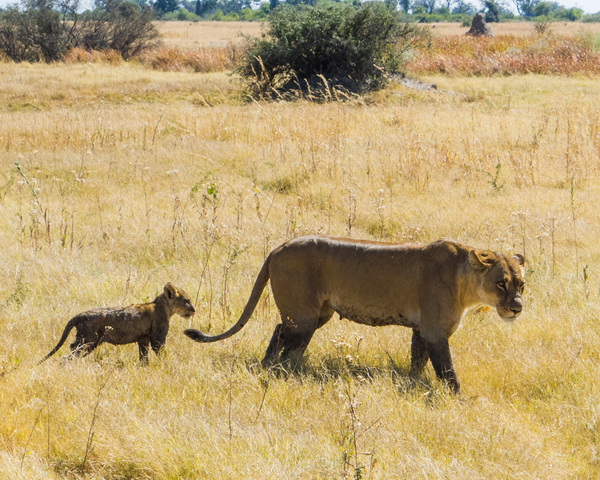
Many scientists believe that the next generation will be the last to see lions in zoos, according to Professor of Biology Daniel York.
York studied the genetics from rare breeds of captive lions, retrieving blood samples over his 11 years of conservation genetics research.
Working alongside Henry Doorly Zoo in Omaha, Nebraska, York developed an interest in the inbreeding and outbreeding of captive lions and joined a project in South Africa at Pilanesberg National Park located outside Johannesburg in the North West Province.
“It looks as though most of the captive lions that are in South Africa now are lions that were imported there from a group in the United States,” York said. “What they had done was collected several hundred lions from various zoos, circuses, and carnivals that wanted to get rid of them.”
Wild lions can be expensive to care for in zoos and circuses, prompting some organizations to sell the lions rather than continue paying for their upkeep.
“A wild animal dealer basically negotiated all of this and ended up collecting all of these residual lions from Europe and the U.S.,” York said. “He shipped them to South Africa, and then those lions got involved in the anti-cachectic breeding and also with the captive lion hunts in South Africa, which are quite controversial.”
York and his team, a large majority of which were students, retrieved blood samples from the various lions in order to compare the close relations between the species.
They focused their work on potential inbreeding or outbreeding between those species, since there has been a drastically dwindling lion population even among captive lions, York said.
The research specific to Johannesburg was conducted on nine sedated lions. Then, York collected the blood samples and brought them back to Hillsdale for further study.
“Initially, we worked alongside vets, so the lions were typically ‘knocked out’ for veterinary work before we could retrieve samples from them,” York said. “Once the lion was immobilized, we got blood samples from them and brought the blood samples back here, extracted the DNA, and did genetic analysis on the DNA.”
Biology Lab Technician Jeannine Lama said genetic analysis involves a process called polymerase chain reaction, which amplifies a specific region of DNA. The genetic sequence, once amplified, can then be sequenced and analyzed.
Apart from merely sedating the animals to retrieve samples, York developed his own unique alternative methods for retrieving data.
“I had the audacity to develop strong techniques for isolating high-quality DNA from scat,” York said. “It is a noninvasive method of collecting DNA without bothering or harming the lions. I was listed on a government grant in South Africa as ‘Daniel York, Professor of Biology, Hillsdale College: Internationally Renowned Scatologist.”
The work that York and his team completed in Africa was noticed by other institutions, including the National Zoo in Morocco.
The directors at the National Zoo then invited York and his team to come to Morocco and study the genetics of their Barbary lions.
Barbary lions had last been seen in the wild in Morocco during World War II , and the directors wanted York and his team to retrieve samples of “the last true Barbary lions.”
These Barbary lions were bred at the zoo after the turn of the century, and York was asked to see if there was anything unique about the lions’ genetics.
“These Barbary lions had different genetics than I had ever seen before, especially in comparison to the lions in South Africa,” York said.
York conducted a similar research project in Africa associated with National Geographic, concerning the status of the white lion population.
They learned after conducting research and genetic tests that the white lion population was in fact stable and not inbred — a finding York said was surprising.
Due to the religious significance of lions in Eastern religions, the National Geographic team wished to re-release the white lions into Kruger National Park, one of the last regions in Southern Africa to have a natural population of lions present.
York said the goals of the National Geographic team were well-intentioned but misguided due to the possibility of outbreeding depression. Outbreeding depression occurs when strong genes that develop in population in a particular area during a particular time frame are diluted because of breeding with different species of lions.
“The last thing you want to do is introduce new genetics into that natural population,” York said. “It will lead to outbreeding depression. They didn’t understand and wanted to call the white lion a subspecies, which it is not.”
York emphasized the need to begin managing lion populations in a way that mimics old migrating patterns.
Moving certain amounts of female and male lions to specific regions would allow the lions to crossbreed as in nature, without the restrictions from man-made boundaries like parks and fences.
Professor of Biology Jeffrey Van Zant said conservation genetics is a useful discipline when looking at small, specific groups of organisms.
“In general, conservation genetics is a crisis discipline,” Van Zant said. “Applications of conservation genetics are place and species-specific. You have to know the biology and the ecology of the species you work with.”
After working with lion conservation genetics research from 1999-2010, York’s involvement in lion genetics conservation eventually came to an end due to the lack of donor funding and demands from other time commitments.
“My work with the lions has given me real life experiences that help me when I go over with students the importance of conservation genetics,” York said. “It helps me answer ‘Why? Who cares?’ and explain what is actually happening. Students were able to learn new techniques, and research is a part of the teaching efforts here at Hillsdale.”
