
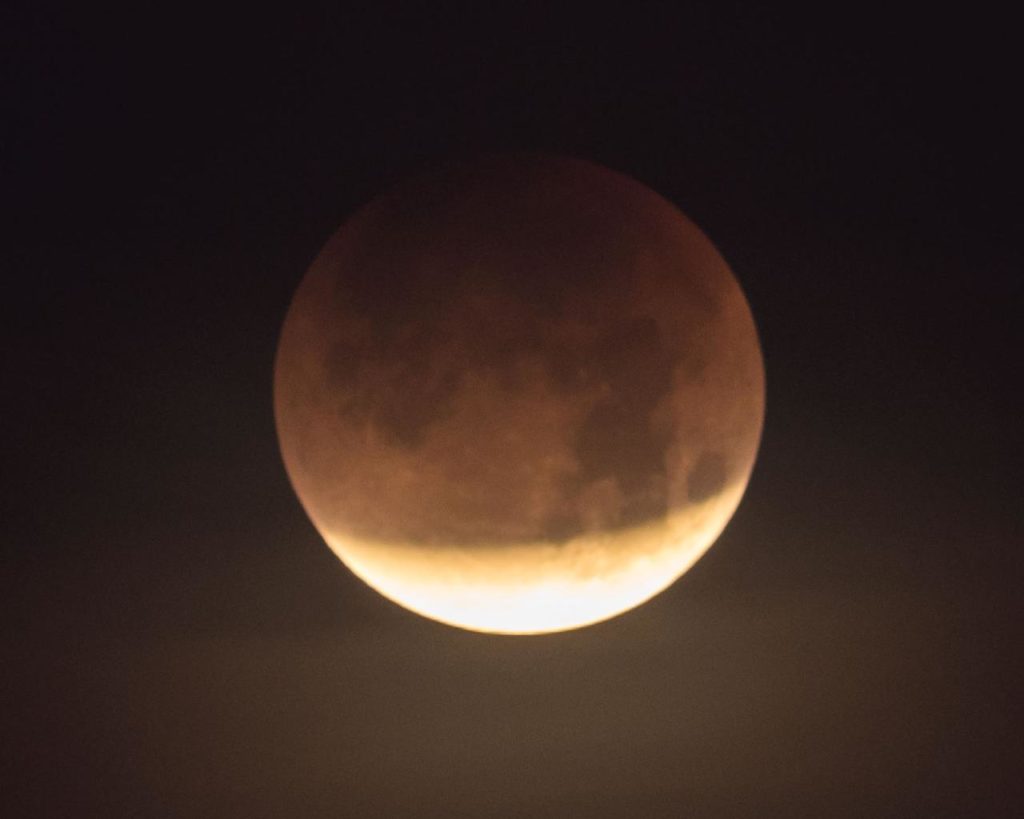
Early Wednesday morning, a lunar eclipse occurred in combination with two other lunar phenomena, dubbed the “super blue blood moon.”
During the lunar eclipse, the Earth passes between the sun and the moon, casting a reddish tint on the surface of the moon.
“The Earth has an atmosphere and the moon doesn’t, so when you have the Earth blocking the sun, you still have the atmosphere,” Assistant Professor of Physics Timothy Dolch said. “We have a blue sky because blue light scatters the most off of the nitrogen molecules, whereas red light keeps going in a straight line. Therefore, most of the light that passes through the earth’s atmosphere and keeps going is red. That sunrise or sunset light that’s coming through, that’s the portion that reflects off the moon back to us.”
Some scientists also use thermal measurements of the moon’s surface during the eclipse to gain information about characteristics of the moon’s surface.
“The whole character of the moon changes when we observe with a thermal camera during an eclipse,” said Paul Hayne of the Laboratory for Atmospheric and Space Physics at the University of Colorado Boulder in a press release. “In the dark, many familiar craters and other features can’t be seen, and the normally nondescript areas around some craters start to ‘glow,’ because the rocks there are still warm.”
The lunar eclipse coincided with a super moon, a term for when a full moon occurs during the point when the moon’s orbit comes closest to Earth, causing the moon to appear slightly larger and brighter than normal. The eclipse also occurred during a blue moon, the term for when two full moons occur during the same calendar month.
