
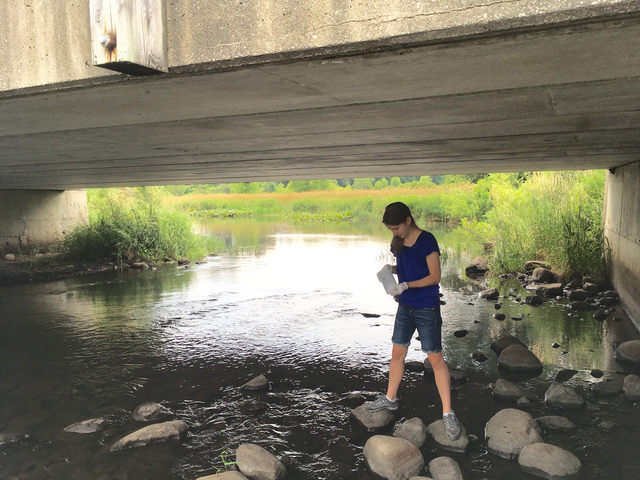
Senior Lauren Barlass collected local water samples downstream from the sewage treatment plant to determine phosphate levels present in the St. Joseph River. Lauren Barlass | Courtesy
To measure very low levels of phosphate in water samples, sometimes researchers have to get creative.
Senior biochemistry major Lauren Barlass spent her summer researching phosphate levels from locally obtained water samples, including the St. Joseph River and Baw Beese Lake. Most kits for testing phosphate rely on a visual scale, which is not sensitive enough to detect low levels and determine whether water samples exceed local limits.
“The purpose of the research is to be able to determine even very low levels of phosphate in natural waters,” Barlass said. “We used a spectrophotometric method to then quantify how much phosphate was in the water through a series of reactions.”
Barlass said she used a flow-injection process to mix water with chemical reagents. From there, the reagents formed a blue complex with the phosphate. This complex absorbed certain wavelengths of light, and the phosphate level could then be determined based on how much light was absorbed. Barlass used an instrument called a spectrophotometer to measure light intensity. The spectrophotometer determined the intensity of the blue light, so Barlass could tell how much phosphate is in the water sample by comparing these measurements to a known standard.
“We were trying to use this method to see if we were able to detect even very low concentrations of phosphate accurately,” Barlass said.
Too much phosphate can have a negative effect on plants and animals within a body of water.
“Microorganisms like phosphate as a nutrition source, but there can be too much of a good thing,” said Professor of Chemistry Mark Nussbaum, Barlass’ research adviser. “The EPA tries to ensure that phosphate levels in natural waters are very low, so we need good analytical techniques to test for them.”
Barlass said one danger of too much phosphate is eutrophication, which occurs when an excess of nutrients causes an increase in plant life, such as an algal bloom, and death for animals who cannot get enough oxygen. This is one of the reasons it is helpful to have an accurate measurement of phosphate levels in water.
When the spectrophotometer measured the level of phosphate in water, it would show a peak that served as a concrete measurement of the phosphate level.
Barlass said she ran into a bit of trouble with some of her instrumentation.
“We still don’t know exactly what caused some of the problems,” Barlass said. “At some points, it would just be constantly having spikes up and down, even when we weren’t injecting anything. We had to try to troubleshoot it to get it working again. That took up about a week or so of my research, which is frustrating, but by the last week, we were able to get it up and running again.”
Senior Randi Block, Barlass’ roommate, said Barlass remained positive despite the difficulties she encountered, particularly with blocked tubing that could mess up reactions.
“During this frustrating process, Lauren always worked diligently to complete each day’s work and to find ways to prevent further problems,” Block said. “No matter how frustrated she got, Lauren always took the time to help me on my own research and never lost her positive attitude. I really admired her constant positivity and smile.”
Nussbaum said contaminants in the water sample could interfere with the measurement by affecting the absorption of light at the particular wavelength or by reacting with other compounds. Additionally, he said that it is easy to get air bubbles in the tubing that can change the signal.
“In general, she got good results,” Nussbaum said. “Her numbers were surprisingly high. I’m suspicious that something else might have been causing that, but I don’t know what.”
Barlass’ research also sought to expand on research another student, Ryan Wiska ’12, began in 2011.
“He only was able to test a few different water samples, and he found that the levels of phosphate were significantly higher directly downstream from the wastewater treatment plant versus upstream,” Barlass said. “He hypothesized that the wastewater treatment plant was adding phosphate somehow into the water, and so I wanted to add more samples to that to try to confirm or refute those initial results.”
Barlass said she found that the phosphate levels were pretty consistently higher downstream versus upstream of the treatment plant.
Nussbaum praised the work that Barlass did, especially in optimizing the time it took to take measurements.
“Lauren did a really good job,” he said. “She showed tenacity and dedication, sticking with it and fighting challenges she faced.”
