
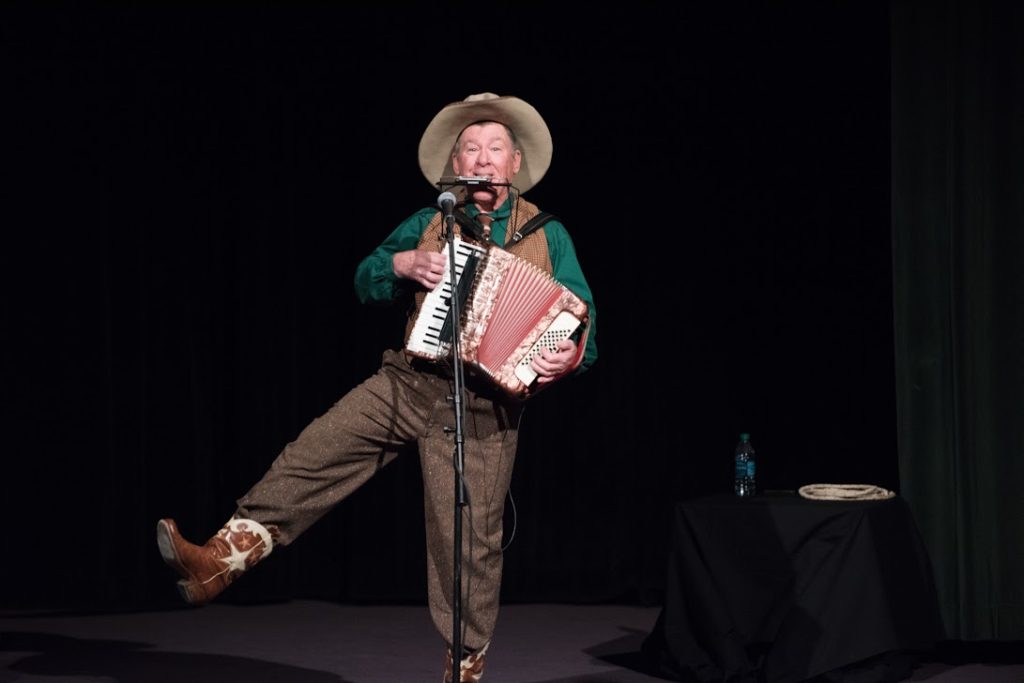
With a yodel and lasso, Sourdough Slim brought the charm of the Wild West to the attendees of the American West CCA. Performing to audiences for nearly 30 years, Rick Crowder, a.k.a. Sourdough Slim, asked his audience if anyone knew the origin of yodeling. “Switzerland,” an audience member said. Slim replied, “Very good. Yodeling started in the Alps—it was the cry of a mountain climbing accident.”
How did your Sourdough Slim act get started?
I started this act in 1988: that’s 29 years ago. As I kid I was a natural ham, just a cut-up. I always did consider myself an entertainer and was very musically inclined. My mom started me on the Hawaiian steel guitar at age 6, and I played the French horn in high school. Performance was a natural progress.
In 1988 I came up with the idea of Sourdough Slim, an entertainer who would yodel and play the accordion. I bought an accordion and taught myself how to play and yodel.
I rode the cowboy cultural renaissance wave that had started around 1985. What really kicked it off was the National Poetry Cowboy Gathering in 1985, and all these people came out for it. Where did they come from? There were 20,000 people there. I’ve been riding that wave ever since. People liked the act and I started pursuing school assemblies and county fairs and showcasing my acts.
Why the name Sourdough Slim?
I’ve been playing music all my life. Back in the 70s, I was in a music group called the Rhythm Wranglers and there were two men in the group named Rick. My name is Rick Crowder, so I picked up the nickname Slim. And I was slim at the time.
When I started the solo act, I wanted something to stand out. I added “Sourdough” because it fit me. I lived my whole life at the foothills of the Sierra mountains in California. The name “Sourdough” is synonymous with that gold country. They use a yeast to make the bread in that region which was very popular during the Gold Rush because you could keep the bread forever.
How did your love for the West come to be?
I grew up on a small 700-acre cow ranch in California. We had a family calf operation. I was very fortunate to be raised in that environment. It was very influential to me.
As kids, Westerns were all that was on TV. I didn’t consider myself a cowboy as a kid. Cowboys were these guys you saw on a silver screen.
Besides a live audience, what other kind of professional experience have you had?
I’ve done yodeling for Disney. For example, I was involved with the production of “Home on the Range.” Unfortunately my yodeling was cut.
I was recently at LucasFilms’ Skywalker Ranch to record yodeling clips. Sound designer Ben Burtt called me up and said, “I hear you’re the only guy for this.” I replied, “Yes, I’m the guy.”
I’ve also done yodeling in commercials for McDonald’s and the Hershey Company. They paid really good, and I didn’t care if they were making fun of it. The accordion, yodeling, my hokey cowboy outfit — I’ve gotten laughs. It’s humbling at times, but I love it. I refuse to conform. I do what I do and am proud of it.
How does a vaudeville singer perform to a modern audience?
I write my own original music as well as sing the traditional Hollywood cowboy songs. The people who come to my concerts want to hear “Don’t Fence Me In” and other traditional songs. So it usually ends up being a balancing act because though sometimes I would rather be playing an old blues song, the audience doesn’t want to hear that.
What does the future of Old Western music look like?
The future doesn’t look bright because it’s like a lot of the traditional art forms. The people that grew up with it come to see and the generation that came after them wasn’t introduced to it, so it’s not part of their life. Festivals like the Cowboy Poetry Gathering try to bring in young people to keep this going. It’s playing out unfortunately. I don’t see a real bright future for it, but because it’s an American icon it may live on.
