
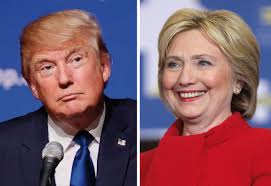
During the most watched presidential debate in history, Republican presidential candidate Donald Trump boldly proclaimed his best quality in running for president: “I think my strongest asset, maybe by far, is my temperament. I have a winning temperament. I know how to win.”
Trump made a lot of false claims at the first debate, but this is the most egregious. Neither Trump nor Clinton embodies the ideal temperament for the executive, and this was clearly on display during the first debate.
Much like Aristotle’s understanding of virtue in “The Ethics,” the ideal temperament for the executive is a mean between two extremes – one who fails to adapt and instead chooses to stay rooted in outdated plans, and another who who shifts so rapidly that he acts in erratic, contradictory ways. The mean between these two is an executive capable of analyzing a situation and adapting accordingly, but who does not shift so much that he abandons all semblance of principles.
Where is our virtuous mean? Certainly not on that debate stage. The ideal executive requires balancing a number of factors – adaptation, prudence, and constancy – none of which Trump or Clinton has mastered. Clinton embodies the executive who sticks to the script and ignores changing circumstances, whereas Trump constantly shifts and contradicts himself. Both of these temperaments should be rejected in favor of an executive rooted in principle, but able to react.
Trump’s constant changes are a clear executive failure. He changes his policies at a dizzying pace. An NBC News article published on Sept. 30 tracks 126 distinct policy shifts across 21 different issues, with 18 shifts on his main platform of immigration.
He changes his opinion of individuals as soon as they choose to support him. “Lil Marco” and “Lying Ted” were granted the respect of “Senators Rubio and Cruz” when they endorse him. Trump’s inconsistency is even worse when coupled with his inability to maintain a respectful demeanor, exhibited most recently in his remarks surrounding the debate.
Trump is more than willing to descend into a level of vulgarity that American politics had left behind. He used Gennifer Flowers to rattle Clinton before the debate and constantly interrupted her — an estimated 51 times — during the debate.
Further, Trump’s remarks toward Alicia Machado following the debate reveal an insecure, bitter man who is far from appearing presidential. Any candidate who points his Twitter followers to check out a woman’s sex tape has illustrated that he is unfit for the presidency based on temperament alone.
Clinton’s inability to adapt, however, is no better. During the debate, Trump would interject comments in the middle of her speech and she would just plow through, seemingly unaware that in those moments he commands the attention of the audience. But a temperament that won Clinton the debate is not the same as the temperament needed for the Oval Office. An admirable example of this within the debate setting is Carly Fiorina’s handling of Trump after his comments about her physical appearance. When prompted to respond on the debate stage, she calmly replied, “I think women all over this country heard very clearly what Mr Trump said,” leaving Trump dumbfounded.
Clinton can’t do this because those reactions and deliveries can’t be entirely scripted. Clinton resists any deviation from the script and has difficulty pretending to act natural, hence her painful delivery of “trumped-up trickle down.” While being clever is certainly not a prerequisite for leading the nation, adapting to shifting circumstances is.
Americans deserve an energetic executive, not a manic one, and certainly not one whose temperament is prone to petty insults and vulgarities or an inability to change.
We should be voting, first and foremost, for a candidate who is fit to be president, who upholds the virtues of the executive office, and neither Trump nor Clinton fit the bill.
Matthes is a senior studying politics and Latin.
