
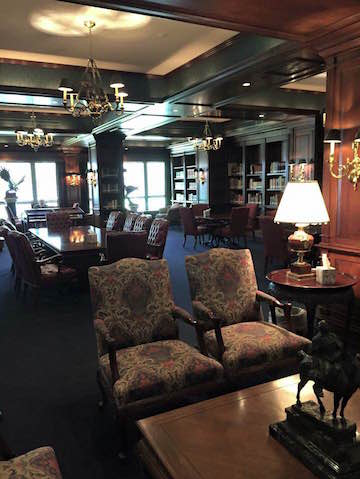
It happens on every campus tour. After Lane and Kendall and the dorms, the student ambassador leads his charges into Mossey Library for the grand finale: the showing of the Heritage Room. The books and paintings and coins are duly admired. And someone (usually a mom) exclaims: “If I were a student, I’d study in here all the time!”
So why don’t our actual students share this sentiment?
The Heritage Room may be a campus showpiece, but student habits suggest it isn’t great for much else. If students and faculty are to get the most out of its impressive contents, the Heritage Room needs a makeover.
Most Hillsdale students have tried to study in the Heritage Room. But nearly all soon learn that other places make better study spaces and migrate out. Students tend to say they like the Heritage Room, but rarely use it themselves.
The problem is that the room tries to do too many things: It is, at various times, a study space, a museum, an archive, a gallery, a lecture hall, and a conference room. Unsurprisingly, these purposes often work against one another.
Want to study in the Heritage Room? Sure, but only if you don’t mind straining your eyes in the dim lighting the rare books require or chatty tour guides who break the sepulchral silence.
Want to admire the books, coins, and art? Only if you’re prepared to feel oddly intrusive as you weather the glances of the few study holdouts.
Want to host a lecture? You’ll need to rearrange the entire room first. Want to attend that lecture? Be prepared to have your view blocked by an eagle.
This confusion of purpose is evident even in the library’s own Heritage Room Use Policy, which recommends the room for “individuals, very small classes and seminars” but does not permit “groups or classes meeting on a regular basis” or “groups meeting for purposes unrelated to the documents in the room,” due to the “monetary and cultural value” of the room’s contents. The upshot is that the Heritage Room is much less than the sum of its extraordinary parts.
So how can the college untangle these conflicting purposes?
To begin, we should consider eliminating the Heritage Room’s redundancies. There is no reason why such events as the Last Lecture series or the panel on Hillsdating shouldn’t take place in either of our campus auditoriums. If we’d miss the homey atmosphere, the Formal Lounge at the Grewcock Student Union will serve.
The question thus becomes: should the Heritage Room serve primarily as a study space or as a gallery showpiece?
Make no mistake: the collections that the Heritage Room displays are excellent. The rare books, including a signed copy of James Joyce’s “Ulysses,” a “Lysistrata” illustrated and signed by Pablo Picasso, and a 1598 copy of Aristotle’s “Politics,” are a delight, as is our antique coin collection. It would be a travesty for these treasures to molder in some campus attic just to give students another study option.
Happily, Mossey Library is already laying plans for a new construction that could solve this dilemma: an archive wing for the library. Such an archive would make the perfect home for the rare collections currently housed in the Heritage Room, which would shine brighter than ever in their own dedicated spaces.
Meanwhile, with its rare contents removed, the Heritage Room could realize its potential as the premiere study spot on campus: leather couches and fireplace made welcoming by lights no longer stingy and dim, but still a warm respite from the harsh fluorescents found elsewhere on campus. Study space would be at a premium in this revamped Heritage Room.
It’s time the college took back the Heritage Room from the admissions department. The holy grail of study spaces is just a library addition away.
Egger is a senior studying history and journalism.
