
Students and faculty said they wanted more substance from Monday evening’s presidential debate and had little confidence in either candidate.
Presidential nominees Republican Donald Trump and Democrat Hillary Clinton had their first showdown Monday evening at Hofstra University in New York to discuss American security, prosperity, and the overall direction of the nation. The answers, however, didn’t impress many on Hillsdale College’s campus.
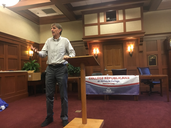
“This election has been a reality TV show from the beginning and will continue to be so,” Professor of Political Economy Gary Wolfram said at a debate analysis Tuesday held by Hillsdale College Republicans. “I didn’t expect them to discuss the issues. Nobody should have.”
Students, however, said the lack of discussion about specific policies troubled them.
“Neither side presented policies supported by principles, which is what conservatives should be voting on,” Young Americans for Freedom President junior English Hinton said.
In a straw poll taken after a debate watch party held by Galloway Residence, College Republicans, and YAF, a majority of students said Trump won. Of 129 respondents, 60 voted for Trump, 35 for Clinton, and 34 said it was a draw.
Wolfram said each of the candidates had hurdles to conquer during the debate. Clinton needed to look professional and kind, handle the email scandal, and force Trump to look ill-suited for the presidency, he said.
“Clinton did what she needed to do,” Wolfram said. “Trump only brought up the emails once, and then no one brought it up again.”
Trump needed to appear presidential and show that he had the right temperament to hold the position of leader of the free world, Wolfram said.
“For the first 20 minutes, he accomplished this, but Hillary kept poking, until he finally reacted in a very Trump sort of way,” he said.
These reactions only reinforced the pre-existing biases against him, Wolfram said.
“This doesn’t mean he can’t overcome this in the next debate,” he said. “It just means he raised his own hurdle.”
Professor of Politics Thomas West disagreed. He said the debate brought out Trump’s strong and Hillary’s weak spots, in regards to the government’s role.
“The most important theme of Trump’s campaign is that the government should serve the common good of all Americans,” West said. “The government is not doing that.”
That Trump is able to continuously stand up to all of the negativity directed toward his campaign on and off the debate stage is an impressive feat, West said, taking aim at debate moderator Lester Holt, anchor of “NBC Nightly News.”
“The moderator was obviously biased against Trump,” he said. “He constantly brought up irrelevant topics that were just distracting.”
Many students said the debate reminded them of a difficult decision come Nov. 8.
“I’m walking out of the debate the same way I walked in,” College Republicans President junior Brant Cohen said. “I’m not more confident in Trump, though he did appear more polished and professional. We just don’t know what he’s going to do.”
Junior Elyse Hutcheson, founder of College Democrats, said she wanted more discussion on social issues.
“They both skirted around important social issues that are very prevalent today,” Hutcheson said. “They focused more on each other than on what’s going on. They need to stop focusing on emails and tax returns.”
Regardless of the topics discussed during the debate, its outcome won’t seriously affect the election, Wolfram said.
“The debate did break Trump’s advancement and slow his momentum,” Wolfram said, “but it won’t seriously affect his campaign, just like Hillary dodging questions on the scandals her campaign is surrounded by won’t seriously affect hers.”
