
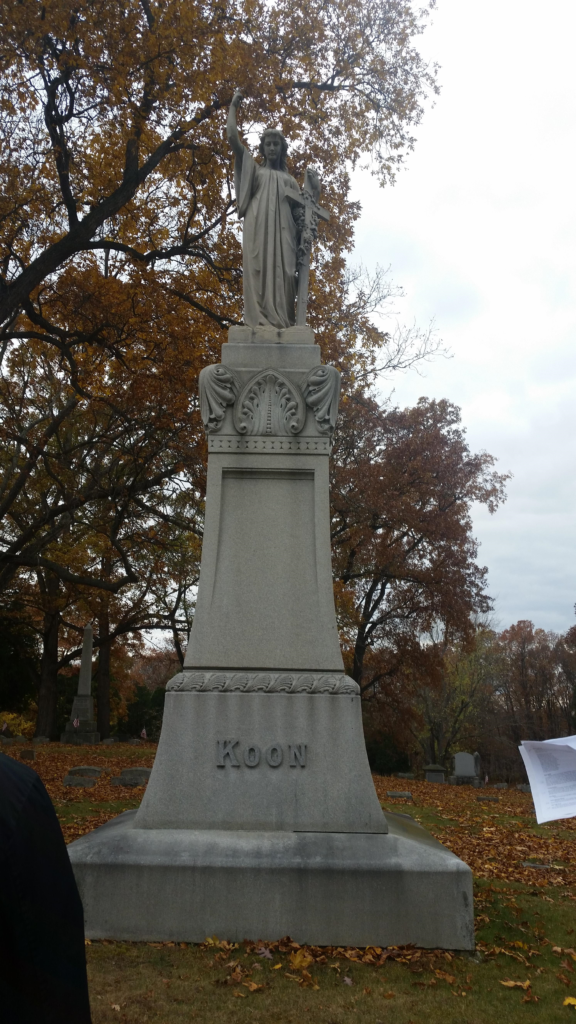
One of the grave sites in the Oak Grove Cemetery.
Breana Noble | Collegian
Sometimes dead people tell better stories than the living, and few do it better than those buried in Hillsdale’s Oak Grove Cemetery.
Richmond Melendy’s tomb is modest, but he started a company of volunteers for the Union army during the Civil War. Lorenzo Dow is buried on the other side of the graveyard — he died with crippled hands because he played so much baseball with his bare hands when he was young, before the invention of the baseball glove.
College Archivist Linda Moore provided more anecdotes about the buried students and friends of Hillsdale College during her cold, windy Oak Grove Cemetery tours Friday and Saturday.
The cemetery, established in 1859, is home to Hillsdale College alumni and faculty as well as notable city representatives. Moore takes students, faculty, and Hillsdale residents on Halloween tours whenever someone asks. This year, the library staff requested she do the tours. For Moore, it’s a chance to showcase her vast knowledge of the college and the city.
The tour, far from morbid, is an interactive history demonstration offering another look into the rich history of Hillsdale.
Pointing to the grave of Daniel Beebe, a Hillsdale resident and land agent, Moore described the man as a great influence on the decision to move Hillsdale College from Spring Arbor to Hillsdale.
“Hillsdale had been a bustling place in the 1840s because the railroad ended here,” Moore said. “Once the railroad moved further west, Hillsdale was just a stop on the railroad.”
Beebe wanted to make the city of Hillsdale more attractive to entrepreneurs and settlers and believed bringing the college to Hillsdale would help market the city. He met with Ransom Dunn, a representative from the college whom Moore said is considered “the grand old man of Hillsdale College,” and convinced him to only consider Hillsdale as the new location for the college. Dunn also rests in the cemetery.
“Ransom Dunn got up on a stump and said, ‘Ah, this is the place for the college,’” Moore said.
Other notable graves include President of Hillsdale College Joseph William Mauck (who died in 1937), Eli Van Valkenburgh (who built the Ambler House, which is now the Health Center and the oldest building on campus), and George Gardner. Gardner’s headstone isn’t that ornate, but the 19th century Hillsdale College art instructor painted a large canvas of West Street, which hangs in the Detroit Institute of Art.
Moore also mentioned Civil War-era embalming methods, which involved arsenic. This became a problem very quickly, Moore said, because arsenic leached into the ground and poisoned the water supply, resulting in fatal consequences.
“Arsenic poisoning: one of the lasting legacies of the Civil War,” Moore said.
Senior Anna Talcott, who took the tour for the first time this year, said she was expecting good stories when she bundled up for the chilly walk with Moore.
“We have such a rich heritage,” Talcott said. “I was not expecting to find the graves of so many familiar names associated with the college like Barber, Slayton, Koon, Mauck, and Galloway. This was my first time, I think hearing everything again would certainly help me remember more of the details.”
The way Moore sees it, cemetery tours are a way of breathing new life into those who have passed on.
“You’re never really dead and gone as long as someone remembers your name,” she said.
