
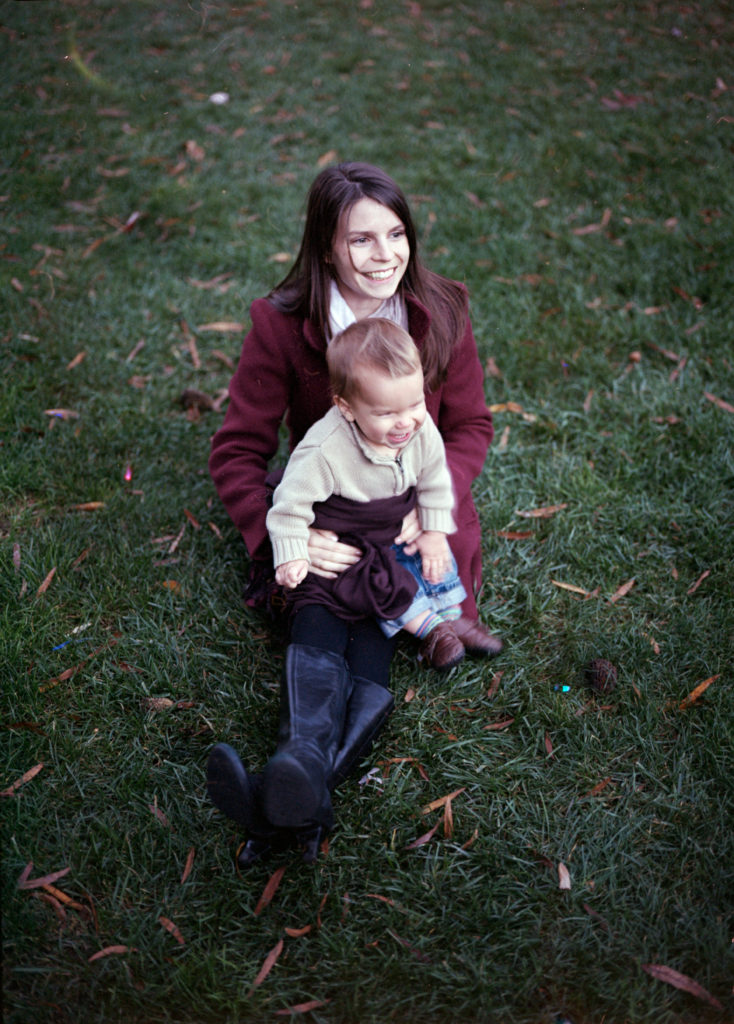
Kjersten Kauffman | Courtesy
When Hillsdale alumna Kjerstin Ostlind was a senior in 2008, she wrote two theses — one, a typical thesis on a Roman poet. Her second, a compilation of her original poems.
The combination of these two aspects of her undergraduate career have led Kjerstin Ostlind ’08, now Kjerstin Kauffman, to her work in poetry today.
“I never did get a classics major at Hillsdale, but I had intended to, so I think a lot of the classical poets deeply influenced me,” Kauffman said. “Now I see a ton of influence from Hardy and Frost. That comes more from graduate work. Different seasons of life have different people. I think that the classical poets were really shaping.”
Kauffman will arrive at Hillsdale today, and will be giving lectures in the days leading up to homecoming weekend. Her husband will also be giving a talk during their time here.
While at Hillsdale, Kauffman wrote for the Tower Light and took a creative writing class taught by Professor of English Daniel Sundahl.
“She would press hard her writing,” Provost David Whalen said. “Her writing was never about the grade. It was about ‘this one particular sentence that just won’t do what I want it to do.’ It was an exquisite exercise in the detail of writing.”
Sundahl affectionately recalls a day when both Nicholas and Kjerstin Kauffman walked into his office and told him they were engaged. They had told him the news before they even told their own parents.
As 2008 graduates, the Kauffmans married just after graduation, and Nicholas spent a few years teaching at a high school in Colorado.
During this time, Kjerstin Kauffman worked at Borders Book & Music Store and as a teacher’s aid. In 2009, she attended the Sewanee Writer’s Conference in Tennessee.
“I think it was at Sewanee that I met a bunch of writers from Hopkins,” Kauffman said. “That was probably part of the reason Nick applied for the Classics Ph.D. program at Hopkins, otherwise I don’t know if he would have necessarily considered that school, but that’s where he ended up applying and being accepted.” During this time, Sundahl had an opportunity to recommend Kauffman to a program.
“My old teacher Dave Smith, who is the chairman at the MFA program at Hopkins, came to visit campus, and it was the perfect opportunity to recommend Kjerstin to the program,” Sundahl said. Kauffman said she applied, was waitlisted, and then accepted at the last minute. At this point, Kauffman had an 18-month-old while beginning her master’s program.
“I think an MFA was like a dream,” she said. “ If I had to do something really exciting and cool, that’s what I’d do.”
Even as a young child, Kauffman said, poetry was a language toward which she was inclined.
“I think poetry’s always been a part of my life,” Kauffman said. “I’ve always responded to poetry in that way. I can remember my mom reading me Christina Rossetti when I was a kid, and loving that, ‘Who can see the wind/ Neither I nor you.’”Halfway through the MFA program, Kauffman’s middle child was born, so the two-year program took three years to complete. Upon completion, she taught creative writing classes at Johns Hopkins University.
“I thought that was really profound to be able to write while having young kids and being pregnant,” she said. “It’s a time which for most women is a complete blur, but I have these poems I wrote and even essays and things. I was doing all this work during that time. I really treasure that just as a record of that time in my life, that season and that experience.”
Sundahl said Kauffman has matured and changed as a writer as well.
“She was very focused on theology and formal in her writing,” he said. “Her poetry has become more maternal, and I mean that in the best way.”
Despite the joys of writing with this inspiration, Kauffman said this time also presented some challenges.
“I was really fried,” she said. “I was really busy. It was logistically challenging. It worked out because my husband was teaching, so we both had more flexible schedules than people typically have, so that worked out nicely.”
Beyond these challenges of working with graduate school and life, graduate school also presented difficulties within it- self that were not present in a Hillsdale education.
“I had heard Dr. Whalen say a number of times that Hillsdale was having a different conversation, that it’s just on different terms,” Kauffman said. “We’re not just having a more conservative or liberal arts angle. It really is a different conversation with a different language and different terms.”
Pragmatically, Kauffman said she had to learn how to interpret things through a feminist or a gender studies or a race lens. This all happened in her first year, when she was thrown into the language by teaching, which she called her crash course in the language of the other conversation.
“In the end, I really affirm the education I had at Hillsdale,” she said. “It was painful. I think that was a challenge. It had some almost spiritual ramifications. This is the way that I think knowledge is. This is the way that I think education should be done. And these things are completely different and aren’t even interacting with my view of what the liberal arts is or should be, and how do I respond to that.”
Ultimately, much of the content in her writing comes from an interaction with other texts and things that she has read. These works, she said, have be come apart of her in a way that naturally flows into her writing.
“To me, it’s so comforting to see, once the poem’s on the page, that, ‘oh, all these other texts are a part of me,’” she said. “It’s just so deeply absorbed into my mind and into my being that, there it is, in the poem.”
