
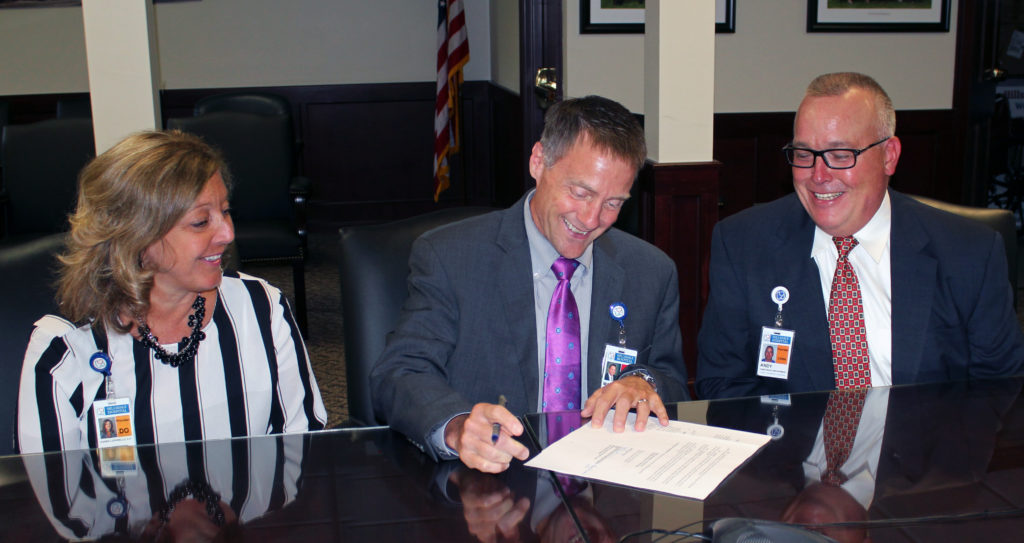
Hillsdale Hospital became a clinical training site for fellows of the University of South Florida College of Nursing Pain Management this past July.
Andy Beigner, a certified nurse anesthetist at Hillsdale Hospital, said the fellowship program is designed for CNRAs who have completed classes at the University of South Florida and are ready to complete 120 hours of clinical work.
“I’m looking forward to providing knowledge, mentoring, and education to allow other people to care for patients with acute and chronic pain,” Beigner said.
John Maye is a PhD CRNA and the director of the College of Nursing Pain Management Fellowship Program. He began the fellowship program in 2016 to improve access to pain management care in rural parts of America.
“We hope that in a community that’s very small, if somebody needs advanced pain care, that they don’t have to drive two hours and wait three months for an appointment,” he said.
Maye added that Hillsdale is fortunate to have the expertise of Beigner. He said smaller hospitals across the country are searching for people who are highly trained in pain management care in order to limit the number of people exposed to opioids.
“Offering alternatives, other than a prescription for opioids, is the wave of the future, and it’s where things should be going,” Maye said.
Hillsdale Hospital’s first fellow will be CRNA Matt Rohlfs, who said he wanted to expand his skills after watching Beigner treat patients.
“His expertise is second to none,” Rohlfs said in reference to Beigner. “It’s an amazing service he offers people.”
Rohlfs added that rural areas throughout Michigan are underserved. Beringer is one of two pain certified CRNAs in the state. After completing his classes and clinical work, Rohlfs would be the third.
Before starting the pain management clinic at Hillsdale Hospital in 2010, Beinger spent 22 years in the Navy – 20 of which he was a CRNA.
As of right now, Beigner’s team consists of a registered nurse and a clinical coordinator. Together, the three see patients two to three days a week. Beigner said his goal is to bring that number up to three or four times a week.
“Having a fellow come work with us isn’t going to necessarily increase my productivity,” Beigner said. “But [Matt] is looking to join my practice and become part of our team.”
Rohlfs began working part time at Hillsdale Hospital in January 2018, but he currently works full time at Henry Ford Allegiance Health in Jackson.
“I really enjoy the smaller hospital setting,” Rohlfs said. “You build a closer relationship with your patients, and that’s something you don’t get at the bigger hospitals.”
Beinger said he treats all of his patients as if they are family and provides multimodal, or multidisciplinary care. Under this type of care, Beinger works with his patients’ primary care providers to develop a treatment plan that may include: physical therapy, occupational therapy, chiropractics, acupuncture, or massage therapy. When it’s appropriate, Beinger also helps patients improve their mental health.
“There’s no ‘cookie-cutter’ method for taking care of patients,” he said. “Everyone is an individual, based on their assessment, imaging, and talking with that patient to find out what’s going on.”
Looking ahead, Maye said he will be sending one or two fellows to Hillsdale Hospital each year for clinical work. Rohlfs will join Beinger in April 2020, upon completing his didactic classwork at the University of South Florida.
Beinger also said he will receive another fellow during the summer of 2020. The fellows, Beinger expects, will spend three to four weeks training with him.
Mayes said the program has had more than 70 graduates, and many of those graduates have gone back to work in rural communities. This year the program will have 20 fellows placed at 12 different clinical sites across the country.
“I’m very happy to be partnering up with places like Hillsdale to offer this service,” Maye said.
